Digitalization grants in Czechia and Slovakia 2026: what is open now
As of October 17, 2026, the main Czech digitalization grant, OP TAK Digital Enterprise, has been closed since April 17, 2026, and no successor appears in the 2026 or 2027 call schedules. Custom software can still be funded in Czechia through Technologies for Local Action Groups II: 50% of eligible costs, projects from CZK 250,000 to CZK 2,999,999, only in Local Action Group areas outside Prague and towns over 25,000 people. In Slovakia, the SIEA vouchers for software development are closed and new programs are only planned so far. Below is each program, what it covers, and the cases where you are better off without a grant.
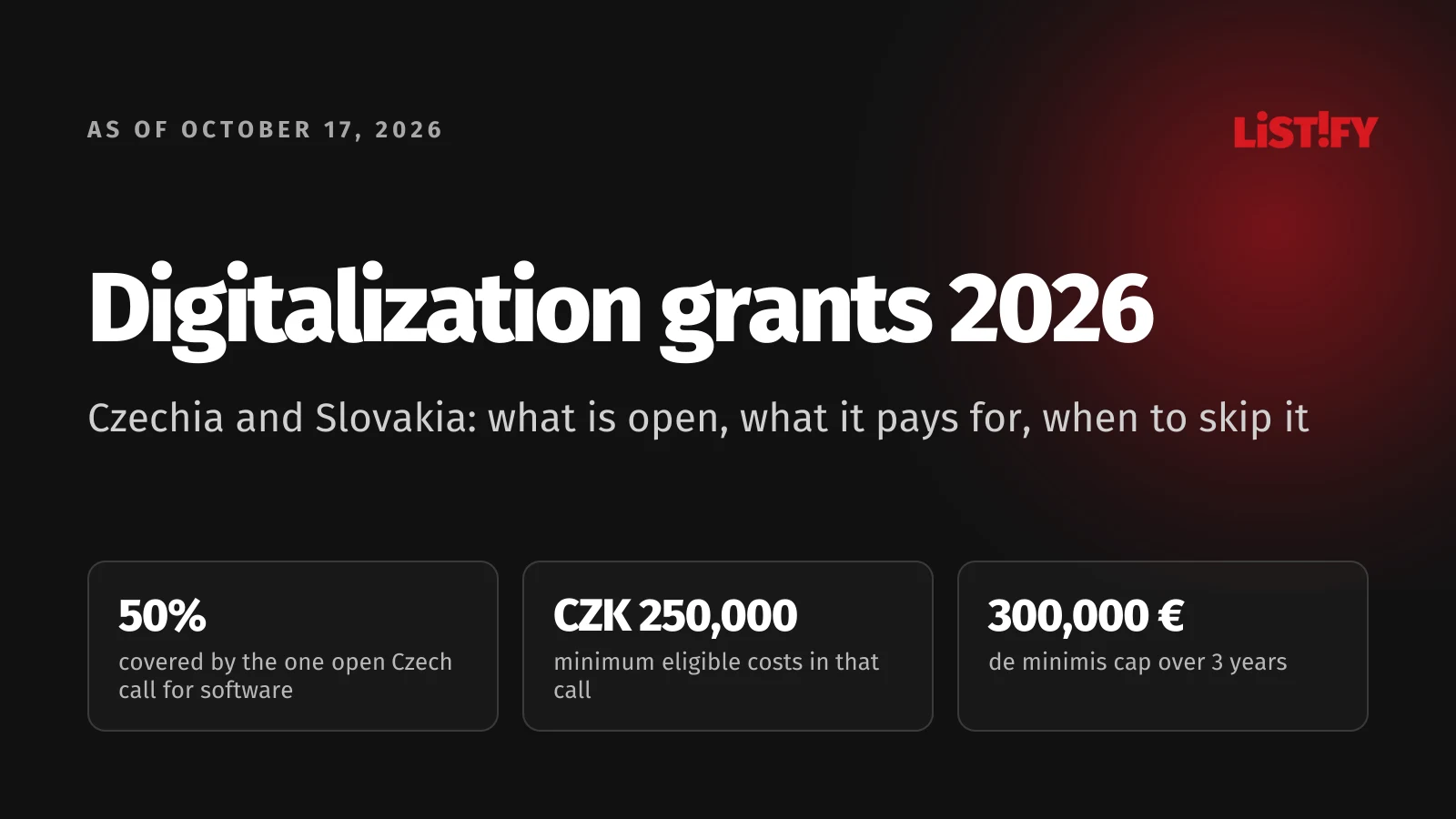
Sooner or later, anyone planning a new system, app or online store asks whether a grant could cover part of it. Many "digitalization grants 2026" roundups still list calls that have already closed. On October 17, 2026, we went through the Czech Business and Innovation Agency (API), the OP TAK call schedules, selected Czech regional programs, the Czech Labor Office, the Slovak innovation agency SIEA, the Slovak Ministry of Investments, Regional Development and Informatization (MIRRI) and the de minimis rules, and kept only what applies today.
Before you look for money, be clear about what the system should deliver and when it pays for itself. Our article on how to calculate software ROI helps. A grant shortens the payback period. It will not rescue a badly scoped project.
01Digitalization grants in 2026: the short answer
- Czech Digital Enterprise is closed. The call ended on April 17, 2026 (API), and the OP TAK schedules for 2026 and 2027 list no new digitalization call for SMEs so far (2026 schedule, 2027 schedule).
- In Czechia, custom software is funded by Technologies for Local Action Groups II. It covers 50% of eligible costs for projects of CZK 250,000 to CZK 2,999,999, with applications from September 1, 2026, to September 1, 2027 (API). It applies only in Local Action Group areas, outside Prague and towns over 25,000 people.
- Czech innovation vouchers pay 75%, but only for services from research organizations. The supplier must be a research organization or an accredited body (API), so they do not fit regular software development.
- Slovak SIEA vouchers for software are closed. The robotics and automation call opened on January 12, 2026, and is now listed as closed. Open SIEA vouchers cover patents, certification and EIC Accelerator advice (SIEA).
- Sign the contract only after you apply. In OP TAK, costs count only from the day you submit the application, and signing a contract or an order counts as incurring the cost (OP TAK rules). SIEA allows work to start only once the voucher is issued (SIEA call).
02What is open in Czechia as of October 17, 2026
| Program | Status on Oct 17, 2026 | How much | Pays for software development? |
|---|---|---|---|
| Technologies for Local Action Groups II | Open, Sep 1, 2026 to Sep 1, 2027 | 50%, projects CZK 250,000 to 2,999,999 | Yes, if the software is integrated with the company information system |
| Innovation Vouchers IV | Open until Apr 30, 2027 | 75%, projects CZK 100,000 to 2 million | Only services of research organizations or accredited bodies |
| Business Vouchers, Vysočina Region | Open until Oct 30, 2026 | CZK 30,000 to 300,000, at least 30% own share | No, audits, analyses and strategy only |
| Training for Companies (Labor Office) | Runs until Dec 31, 2028 | Up to CZK 478.19 per hour and participant | No, employee training only |
| Digital Enterprise I (OP TAK) | Closed Apr 17, 2026 | 25% to 45%, projects from CZK 2.5 million | Yes, but the call has ended |
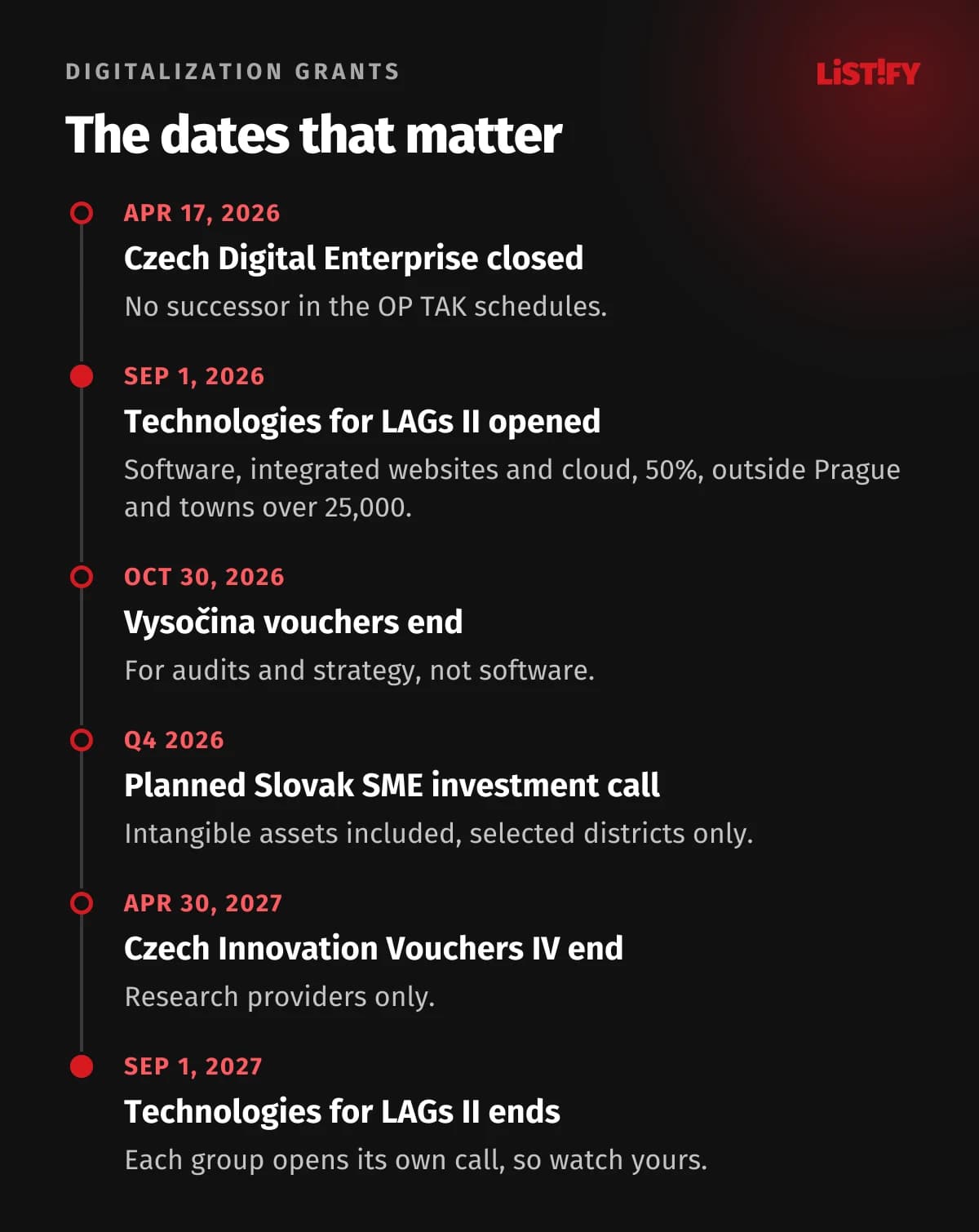
The Digital Enterprise, Digital Technologies I call was the key Czech grant for digitalization: it funded software, IT infrastructure and services for projects from CZK 2.5 million, in five regions only (Central Bohemia, Plzeň, South Bohemia, Vysočina and South Moravia). The Ministry of Industry and Trade extended it to April 17, 2026, because the money had not run out (API). The 2026 schedule (update valid from August 6, 2026) and the 2027 schedule (valid from September 16, 2026) contain no successor (API). The ministry calls the schedules indicative, so calls can still be added, but none has been announced.
03Technologies for Local Action Groups II: the one open Czech call for software
The call was announced on April 7, 2026, and takes applications on a rolling basis from September 1, 2026, to September 1, 2027. It has CZK 540 million in total (call text). Support goes through Local Action Groups (MAS in Czech), regional partnerships of municipalities, businesses and nonprofits.
No local call, no application. You do not apply to the agency directly. A Local Action Group with an approved program framework first issues its own call, known as a MAS call, which sets the conditions under its regional strategy. The group must publish it on its website and in the central database of Local Action Groups (LAG database). You submit a project plan into the MAS call, and the group approves or rejects it. Only an approved plan goes into the ministry call as a grant application in ISKP21+, together with the group’s statement that it fits the approved strategy, and the group countersigns your application in ISKP21+ (call text). If your group does not issue a MAS call with this focus, you cannot apply.
Eligible costs include buying and implementing software, including installation and commissioning, cloud subscriptions during the project, and, explicitly, websites with extended functionality, such as a connection to a warehouse, an online store or a booking system (annex 3). The key condition: the technology must exchange data with a higher-level company information system that connects at least two areas, such as finance, warehouse, maintenance or service, production, sales, customer relations or HR. A custom system that links sales with accounting can meet this condition, as long as it also meets the other rules below.
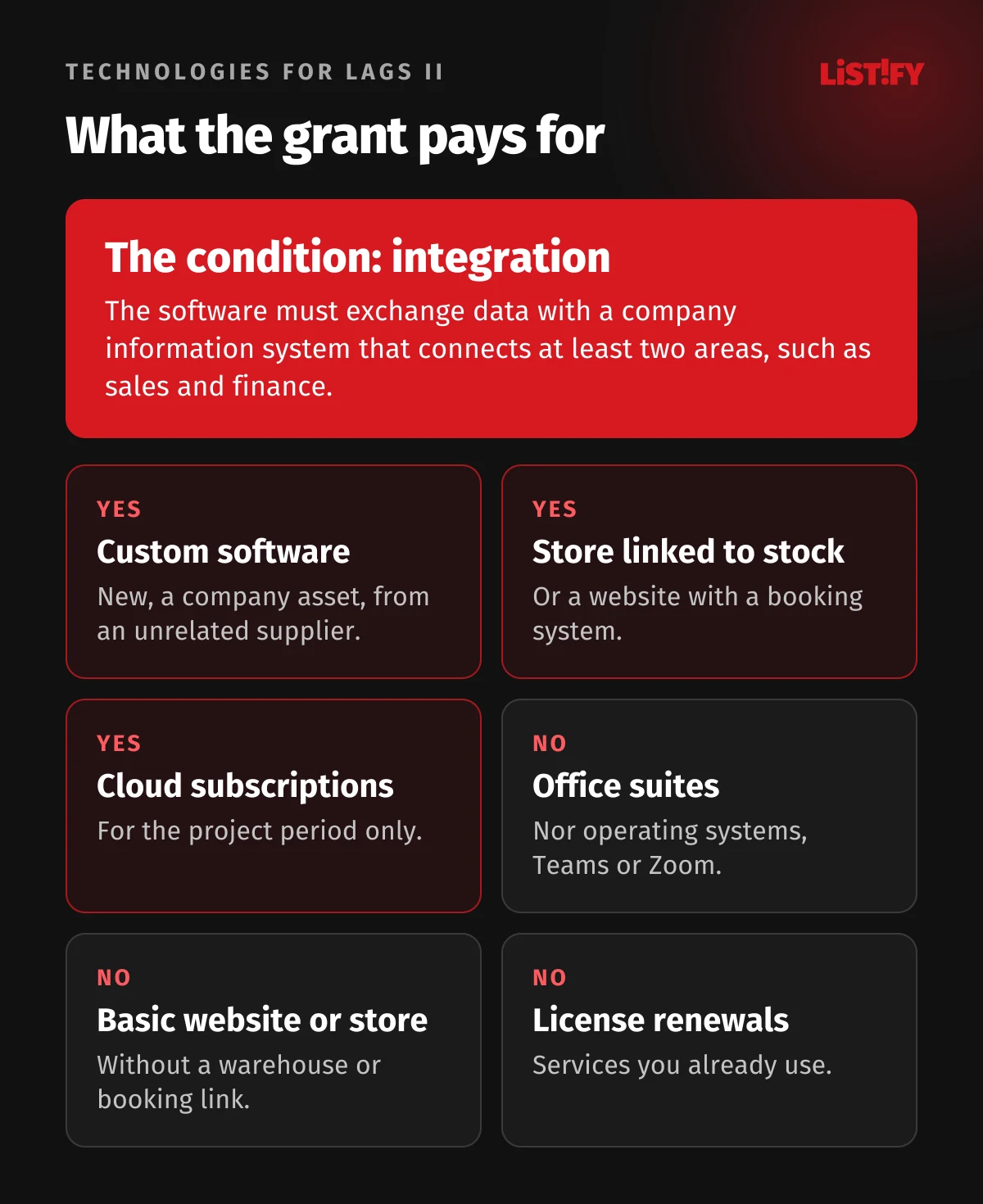
Not eligible: office suites, operating systems, remote desktop and video conferencing software such as Teams or Zoom, UX design, and a basic website or simple online store without a connection to a warehouse, booking system or production configurator. Renewing a license you already use is not eligible either (annex 3).
- The applicant must be an SME registered as a Czech income taxpayer continuously for at least two tax periods before applying.
- The project must take place in a Local Action Group area with an approved program framework, outside Prague and municipalities over 25,000 people.
- You first submit a project plan into your Local Action Group’s own MAS call. Only an approved plan goes into ISKP21+ as an application, with the group’s statement on fit with its strategy, and the group countersigns it.
- The software must be new, recorded and depreciated as a company asset, bought from an unrelated supplier at market price, and must add new functions. Even a 1% stake makes a supplier related.
- Every budget item needs two price quotes. One is enough only with a justification, for example for a highly customized solution.
- You must keep the result for at least 3 years after the project ends, and each applicant can have only one project in the call.
- Support is de minimis aid and is paid after the project is completed and accounted for.
The call adds a flat 7% on top of direct costs for indirect costs, with no invoices required. The CZK 250,000 minimum and CZK 2,999,999 maximum include this flat rate, so direct costs must be at least CZK 233,645 and at most CZK 2,803,737. By our calculation, a system with CZK 1,000,000 in direct costs gives CZK 1,070,000 in eligible costs and a grant of CZK 535,000. You pay the full amount upfront and receive the grant only after the final accounting.
- Innovation Vouchers IV75%
- Vysočina vouchers70%
- Technologies for LAGs II50%
- Digital Enterprise I (closed)45%
For Vysočina, 70% is the complement of the minimum 30% own share. For Digital Enterprise, 45% was the upper limit by region and company size. Sources: API, Vysočina Region.
04Other Czech options: vouchers, training and EDIHs
Innovation Vouchers IV take applications until April 30, 2027. On September 24, 2026, the Ministry of Industry and Trade raised the budget from CZK 250 million to CZK 350 million because of high demand. They cover 75% of projects from CZK 100,000 to CZK 2 million, but only services from research organizations or accredited bodies, outside Prague, for companies with at least two closed tax periods (API).
The Vysočina Region offers Business Vouchers 2026 with CZK 7 million in total: CZK 30,000 to CZK 300,000, at least 30% own share, applications until October 30, 2026. The region states plainly that the program does not fund the purchase of commercial software. It pays for digital and cybersecurity audits and digital transformation strategies, and the project may start only once the grant agreement is signed (Vysočina Region). A regional voucher works well as a cheap first step: the analysis gives you a clear brief and a more accurate development quote.
Training for Companies, run by the Czech Labor Office until the end of 2028, supports IT skills beyond the basics with up to CZK 478.19 per hour and participant, wage contribution included. Under the conditions in effect from July 1, 2026, a course must have at least 50 hours per participant, and one person can be funded for at most 80 hours, or 100 hours from age 50 (Labor Office, conditions).
European Digital Innovation Hubs (EDIHs) are not a grant program for software, but they offer "test before invest", financing advice and training (European Commission). EDIH CTU at the Czech Technical University continues from January 2026 with a strong focus on AI (CTU).
05What is open in Slovakia as of October 17, 2026
| Program | Status on Oct 17, 2026 | How much | Pays for software development? |
|---|---|---|---|
| SIEA vouchers: robotics and automation | Closed, announced Jan 12, 2026 | 3,000 to 30,000 euros, up to 85% | Yes, but only for production, logistics, warehousing, maintenance and quality control |
| SIEA vouchers: patents and certification | Open | 2,000 to 15,000 euros, up to 85% | No |
| SIEA vouchers: EIC Accelerator advice | Open | 2,000 to 20,000 euros, up to 85% | No, advice on the application only |
| Program Slovakia: SME investments in JTF regions | Planned, launch Q4 2026 | Budget 16,890,000 euros | Intangible assets yes, conditions not yet published |
| Digitrans (MIRRI) | In preparation | Pilot voucher 2,000 euros | Not known yet |
The SIEA robotics and automation call ran under a national innovation project from January 12, 2026, with an indicative budget of 2,000,000 euros that SIEA increased on April 13, 2026. It explicitly covered software for logistics processes and the automation and digitalization of production, logistics, warehouse, maintenance and quality control. The work had to be finished within 3 months of the voucher being issued and could start only once it was issued (SIEA call).
The Program Slovakia 2026 call schedule (version 3.0, updated July 22, 2026) has no general digitalization call for SMEs. The closest is a planned call by the Ministry of Economy for productive SME investments in tangible and intangible assets, limited to districts in Upper Nitra and parts of the Banská Bystrica and Košice regions (schedule). The MIRRI pilot Digitrans gave 65 firms a 2,000 euro digital voucher with expert advice, and MIRRI plans support for up to 500 businesses a year until 2030 (MIRRI). We found no open call for either as of October 17, 2026.
- EU72.9%
- Czechia70.8%
- Slovakia62.9%
Enterprises with 10 to 249 employees, excluding the financial sector, Digital Intensity Index version 4. Source: Eurostat, isoc_e_dii.
06When you may start: the most common way to lose a grant
The OP TAK rules are clear: eligible costs can arise no earlier than the day you submit the application, and a cost arises when you sign a contract, issue an order or reach the date of the taxable supply (the tax point), whichever comes first (OP TAK rules, version 10). Sign a development contract a week before applying, and none of the costs under that contract are eligible. If the contract covers the whole build, you lose the grant for the whole project. SIEA vouchers are stricter still: activities count only after the voucher is issued.
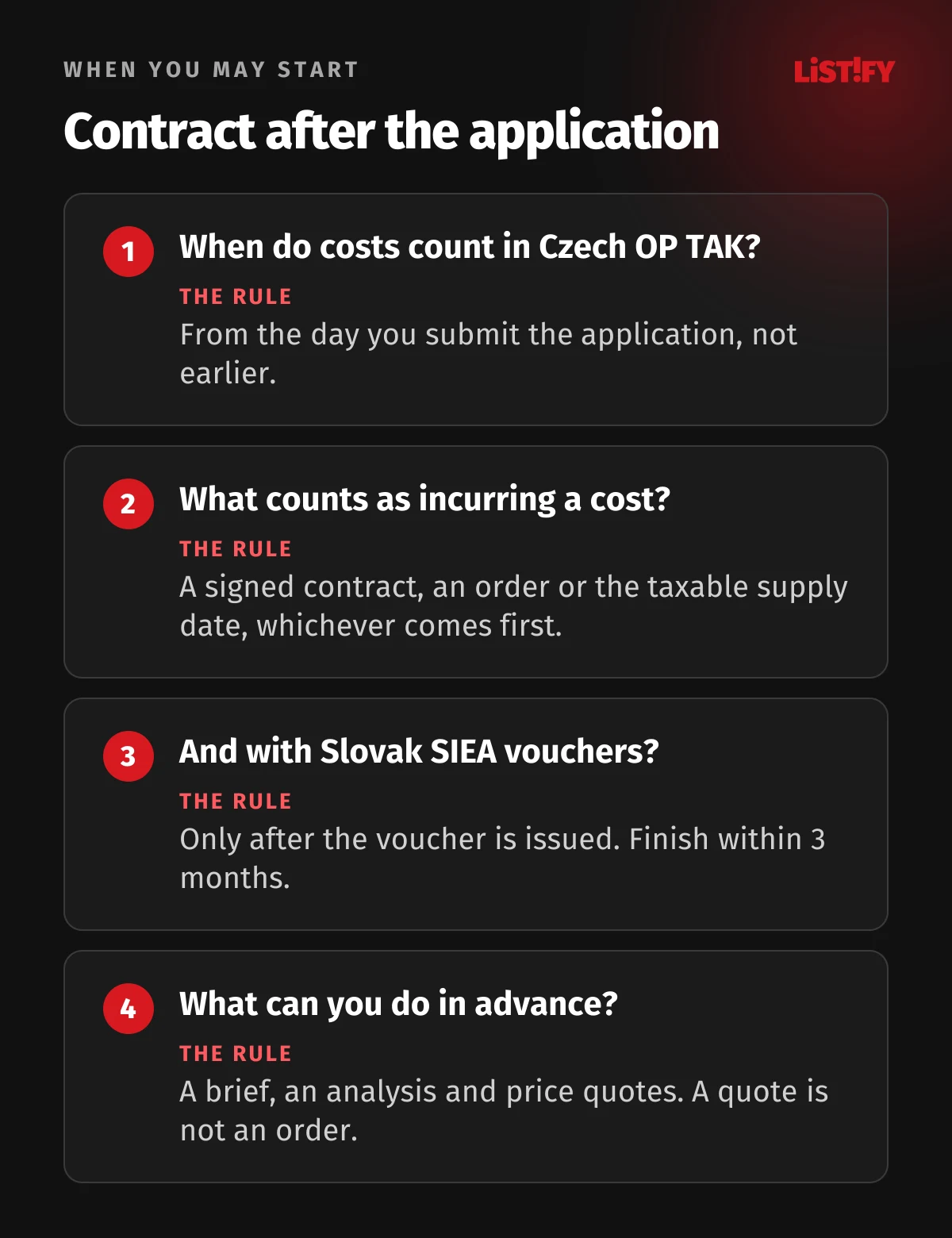
You can prepare before applying: a brief, a process analysis, a study or price quotes. A quote is not an order and does not bind you.
07De minimis: how much aid one company can take
Technologies for LAGs II, Innovation Vouchers, Training for Companies and the SIEA vouchers are all de minimis aid. Under Commission Regulation (EU) 2023/2831, in force since January 1, 2024, one undertaking can receive at most 300,000 euros over a rolling three-year period (European Commission, Czech Office for the Protection of Competition). Linked companies, such as a parent and its subsidiary, count as one undertaking.
Check how much headroom you have before you write an application: in Czechia in the public part of the de minimis register (register), in Slovakia in the IS SEMP register run by the Antimonopoly Office (IS SEMP).
08When a software grant is not worth it
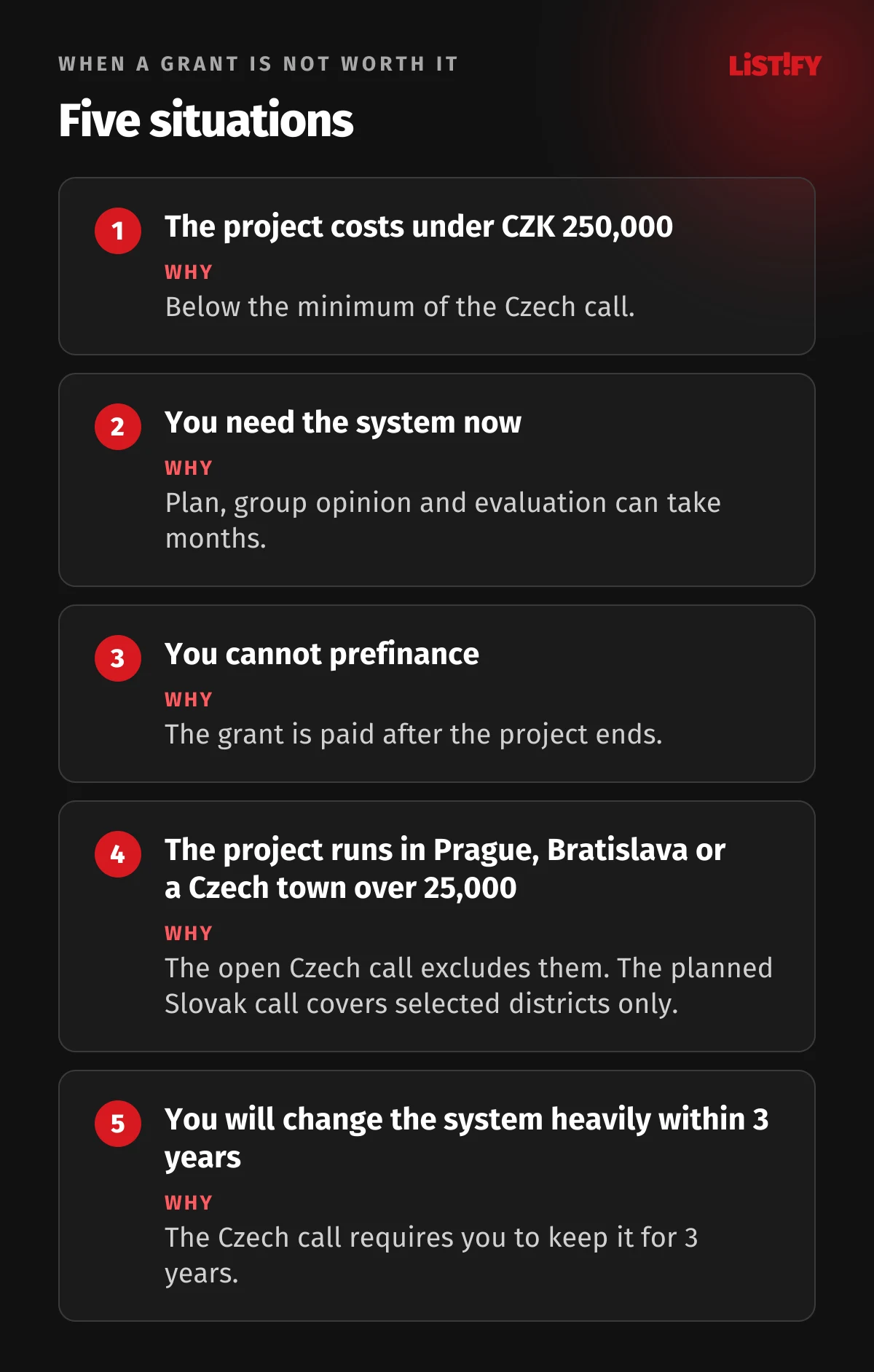
- The project is small. Automating one process often costs less than about CZK 234,000 in direct costs, the minimum once the flat rate is added. The paperwork and waiting do not pay off on a small job.
- You need the system now. The plan, the Local Action Group opinion, the application and the evaluation can easily take months, and you cannot sign a contract before you apply. If the system saves dozens of hours a month, the lost months can cost more than the grant.
- You cannot prefinance. The grant is paid afterwards, so you fund the whole project from your own money or a loan.
- Your project runs in Prague, Bratislava or a Czech town of over 25,000 people. The Czech software call excludes Prague and towns over 25,000, Czech Innovation Vouchers exclude Prague, and the planned Slovak investment call covers selected districts only. We found no open call for software in Prague or Bratislava as of October 17, 2026.
- You will change the system heavily within three years. The Czech call requires you to keep the result for 3 years. For a product still looking for its market, start with a smaller first version without a grant. Our article From idea to MVP shows how.
Nobody can guarantee a grant. Projects go through evaluation and can be rejected, and the grant provider always decides which costs are eligible. Be careful with anyone who promises a "sure grant".
09How to apply for Technologies for LAGs II, step by step
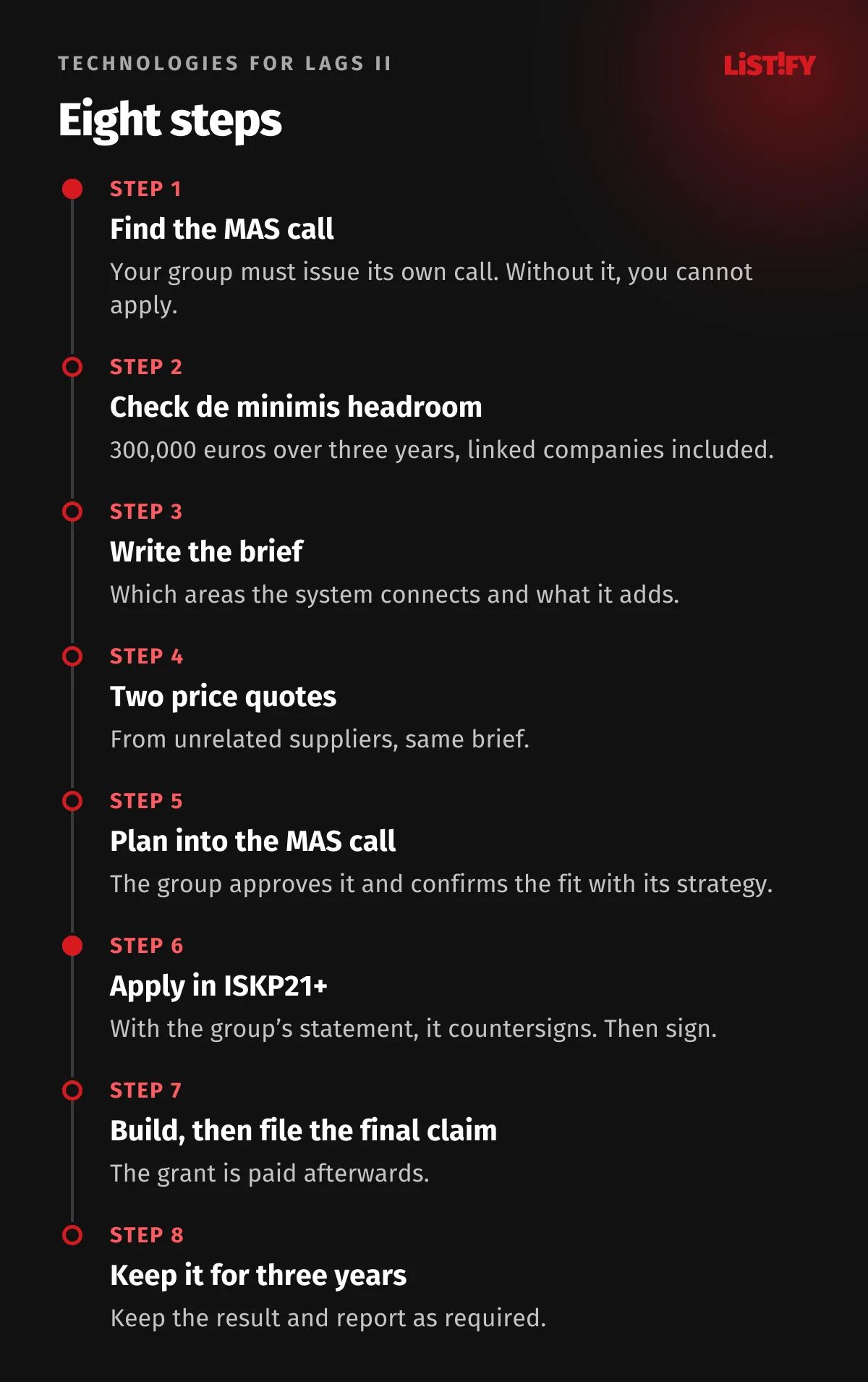
- Check that your premises are in a Local Action Group area and that the group has issued a MAS call with this focus (LAG database). Without one, you cannot apply.
- Check your de minimis headroom in the register (register).
- Write the brief: which processes and areas the system connects, which company system it integrates with, and what new functions it brings.
- Ask two unrelated suppliers for quotes on the same brief.
- Submit your project plan into the MAS call and wait for the group to approve it and issue its statement on fit with the strategy.
- Apply in ISKP21+ with the group’s statement; the group countersigns the application. Sign the contract or order only after you have applied.
- Complete the project, submit the final accounting and receive the grant.
- Keep the result for at least 3 years and report what the call requires.
10What we can help with, and what we cannot
We do not handle grants or write applications. Two things every application needs are a clear brief and price quotes. We can help with both: we describe the functions, the integration with your current system and the schedule. For the project itself, we put a fixed price and deadline in the contract, which you sign once the grant rules allow it.
For a sense of budget: a custom CRM starts at CZK 150,000, an ERP and warehouse system at CZK 300,000, accounting integration adds CZK 30,000, and a company online store starts at CZK 240,000. Prices exclude VAT and are starting points; the final price depends on scope (pricing). Keep in mind that Technologies for LAGs II requires at least CZK 250,000 in eligible costs, the flat rate included. Our article on what a CRM costs over 5 years compares custom and off-the-shelf systems.
Before you sign with any supplier, with or without a grant, go through 20 questions to ask before choosing a software development company and what a software development contract must include.
11FAQ
How do you apply for Technologies for Local Action Groups II?
Through your Local Action Group. The group must issue its own MAS call, into which you submit a project plan. The approved plan then goes into ISKP21+ as an application with the group’s statement on fit with its strategy, and the group countersigns it. If the group issues no such call, you cannot apply (call text, LAG database).
Which digitalization grants are open in Czechia in 2026?
As of October 17, 2026, mainly OP TAK Technologies for Local Action Groups II (software, integrated websites, cloud, 50%, until September 1, 2027) and Innovation Vouchers IV (research services, 75%, until April 30, 2027). The Vysočina Region accepts voucher applications for audits and strategy until October 30, 2026 (API).
Will there be a new Digital Enterprise call?
Neither the OP TAK schedule for 2026 (valid from August 6, 2026) nor the one for 2027 (valid from September 16, 2026) includes one (API). The schedules are indicative, but no call has been announced as of October 17, 2026.
Can a grant pay for custom software development?
In Czechia, yes, under Technologies for Local Action Groups II, if the project is in an eligible Local Action Group area outside Prague and towns over 25,000 people, and the software is new, integrated with the company information system across at least two areas and bought from an unrelated supplier (annex 3). In Slovakia, the SIEA vouchers that covered software are closed as of October 17, 2026 (SIEA).
Can a grant pay for an online store?
In the Czech call, only an online store with extended functionality, such as a warehouse connection. A basic website or simple online store without integration is explicitly ineligible (annex 3).
Can I sign the supplier contract before applying?
Not if you want the costs covered. In OP TAK, only costs arising after you apply are eligible, and a contract or order counts (OP TAK rules). With SIEA vouchers, work can start only once the voucher is issued. Asking for quotes is fine.
How much de minimis aid can a company receive?
At most 300,000 euros over a rolling three-year period, linked companies included (European Commission). Check your balance in the Czech de minimis register or the Slovak IS SEMP.
12Sources
- API: OP TAK calls overview (CZ)
- API: Technologies for Local Action Groups (CLLD) II (CZ)
- API: call text, Technologies for LAGs II (PDF, CZ)
- API: annex 3, eligible costs (PDF, CZ)
- API: annex 2, rules for applicants (PDF, CZ)
- API: Digital Enterprise, Digital Technologies I (CZ)
- API: Innovation Vouchers IV (CZ)
- API: OP TAK and call schedules (CZ)
- OP TAK call schedule 2026, update 5 (XLSX, CZ)
- OP TAK call schedule 2027 (XLSX, CZ)
- OP TAK rules for applicants and beneficiaries, general part, version 10 (PDF, CZ)
- National Network of Local Action Groups (CZ)
- LAG database: calls of individual groups (CZ)
- Vysočina Region: Business Vouchers 2026 (CZ)
- Labor Office: Training for Companies (CZ)
- Labor Office: conditions from July 1, 2026 (PDF, CZ)
- Office for the Protection of Competition (ÚOHS): de minimis aid and register (CZ)
- Czech de minimis register, public part
- SIEA: innovation vouchers (SK)
- SIEA: robotics and automation call IP_RAP_126 (PDF, SK)
- SIEA: de minimis scheme DM 18/2024 (PDF, SK)
- Program Slovakia: 2026 call schedule, version 3.0 (PDF, SK)
- MIRRI: Digitrans (SK)
- Slovak Antimonopoly Office: IS SEMP register (SK)
- European Commission: de minimis Regulation 2023/2831
- European Commission: European Digital Innovation Hubs
- CTU: EDIH CTU from 2026
- Eurostat: digital intensity of enterprises (isoc_e_dii)
Call status, dates and amounts are as of October 17, 2026. Calls change, so always check the current call text with the provider before you apply.