Czech hosting vs. global cloud: Differences and recommendations
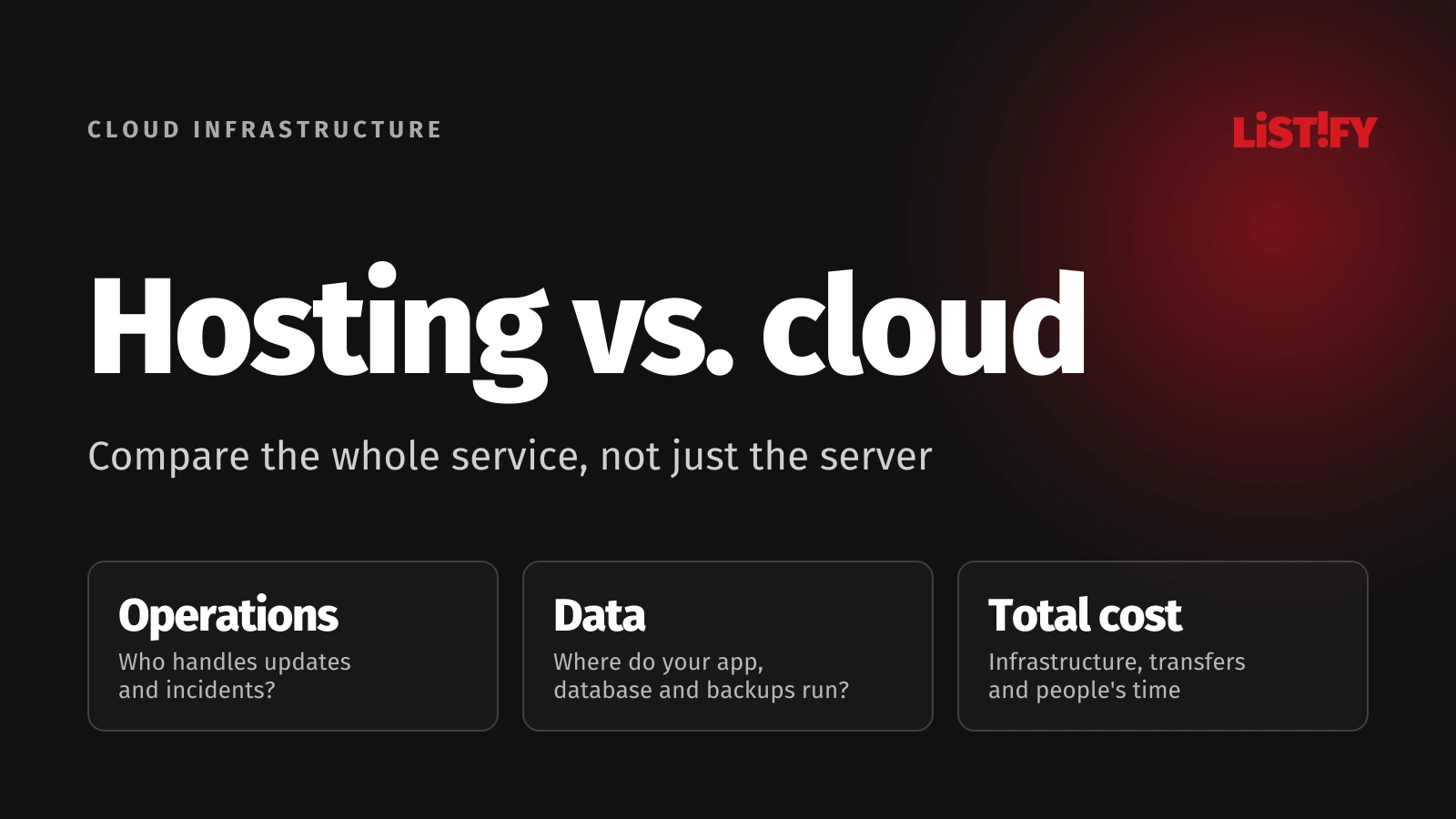
Your supplier recommends Czech hosting for local support. Your developer wants a global cloud for its application services. The right choice depends on what you run, who operates it and what the complete year will cost. Compare the same service scope, the actual location of your data and the response to a failure. The provider’s country alone cannot settle the decision.
This guide is for owners of websites, online stores and internal systems who need to make an infrastructure decision without their own operations team. For providers and technical requirements, see our 30 tips for choosing hosting and a CDN. Here we focus on ownership, cost and whether changing your current setup is justified.
01Separate the provider, the location and the service model
“Czech hosting” can mean shared web hosting, a rented virtual server or a managed environment. A global brand may sell a server you maintain yourself or a platform that takes care of part of the work. A Czech company does not necessarily keep every component in Czechia, and a global provider may let you deploy in a European region.
Ask three different questions: who is your contractual supplier, where does each part of the project run, and who maintains each layer? Compare prices only after those answers are clear. A server rental without operating system maintenance is a different service from a managed environment with monitoring and recovery.
| Decision layer | What to include in the proposal |
|---|---|
| Provider | Contracting entity, support language, escalation and billing. |
| Location | Regions for the application, database, files, backups and logs. |
| Management scope | Ownership of the operating system, application, database and incidents. |
| Business requirement | Acceptable downtime and loss of recent data. |
The largest difference is often between these service models rather than between Czechia and another country. Before comparing price, identify the responsibility model behind each offer.
| Model | What you primarily buy | What to verify |
|---|---|---|
| Local shared hosting | Space for a website in a predefined environment. | Compatibility, limits and application support scope. |
| Local managed server | Capacity and an agreed set of administrator tasks. | Whether management includes the database, recovery and on-call cover. |
| Global cloud server | Infrastructure with control over configuration. | Who takes ownership of Linux, the application and spending. |
| Global managed platform | An application runtime with some operations handled by the platform. | Operating limits, full-stack cost and the exit route. |
02When Czech hosting is a sensible option
For a company website, content site or conventional online store, a local provider with suitable management can be a practical choice. Czech support, straightforward billing and an accessible handover process may be useful to your team. Confirm those qualities for the specific service. A local telephone number and national domain are not evidence of reliable support.
For an established website, do not ask only whether a larger cloud is available. Establish whether the current hosting limits the business: perhaps stock imports time out, orders slow down during campaigns, or recovery is unclear. If the application is responsible for the problem, migration may change the invoice while leaving the underlying fault intact.
A useful brief covers normal traffic, campaign peaks, required technologies and the person expected to intervene. A smaller company may gain more from clearly assigned management than from an extensive catalogue of services that nobody can operate confidently.
03When a global cloud or managed platform is worth considering
Consider cloud services when the application needs multiple environments, separate background jobs, automated deployments or users in several countries. A managed platform may reduce some operational work. Check its limits, including job duration, file size, database connections and export options. Moving an older application may require changes rather than simply copying its files.
A virtual server rental creates different responsibilities from a managed database. For EC2, AWS leaves the guest operating system and applications under the customer’s management. A larger brand therefore does not remove the need for an operator. See the AWS shared responsibility model.
If you already need a wider set of cloud services, continue with our AWS, Google Cloud and Azure comparison. To choose between local hosting and cloud, first identify the capabilities you will actually use and the people responsible for them.
04A practical comparison for three business situations
| Situation | Starting point to evaluate | The deciding question |
|---|---|---|
| Company website and enquiries | Managed web hosting or a straightforward platform. | Who checks forms, updates and recovery? |
| Store with campaigns and imports | Managed hosting or cloud suited to the application. | Can checkout and imports handle a realistic peak? |
| Internal system or growing SaaS | A platform or cloud with agreed management. | How are releases, recovery and costs controlled? |
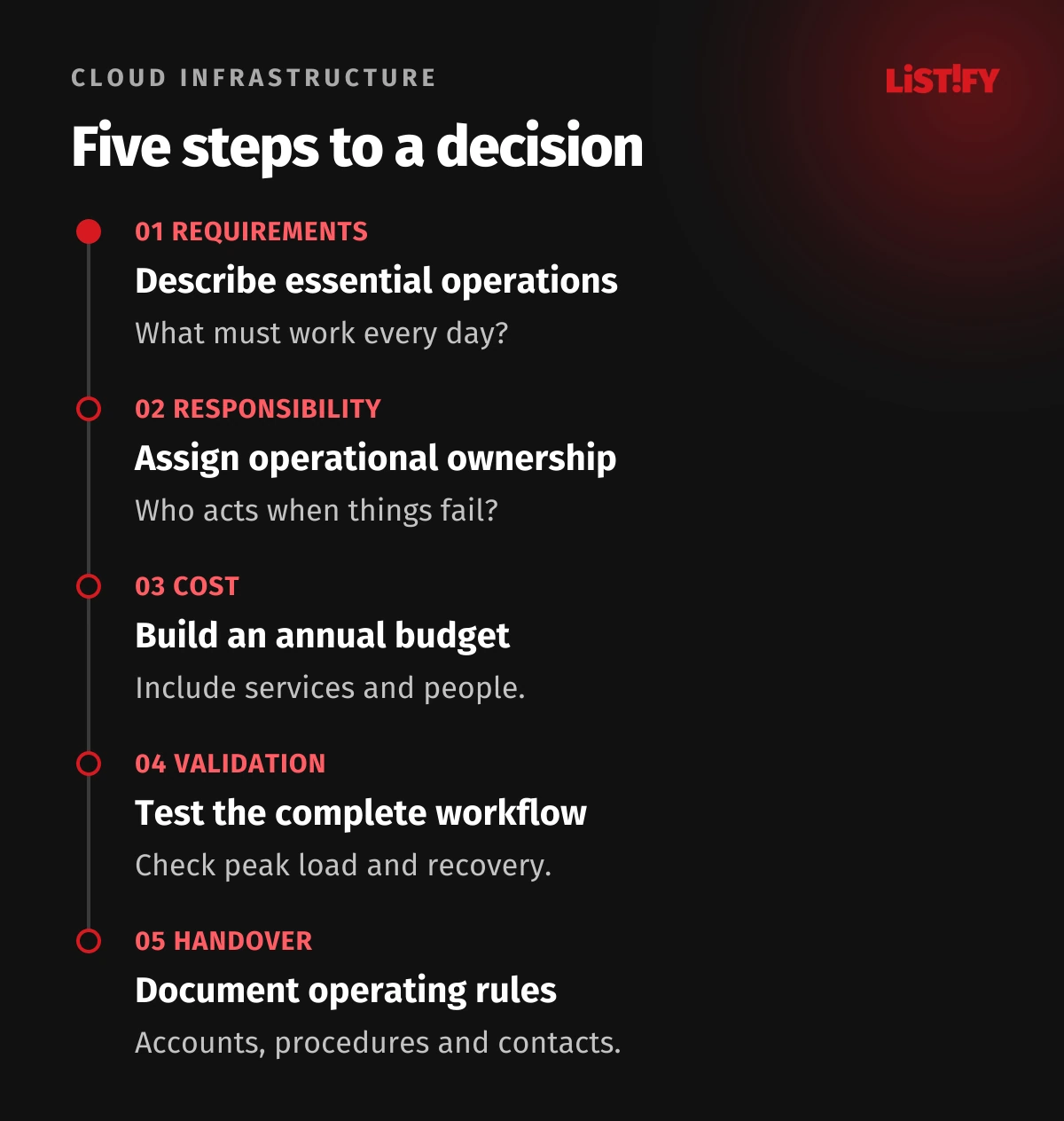
An internal accounting tool used during working hours can have different priorities from a store accepting payments throughout the weekend. Start the shared requirements with the effect of an outage. Then address performance, service and price. Two proposals are comparable only when the suppliers are responding to the same operational scenario.
05Server location is only one part of speed and data control
Customers need to complete a task. Compare product pages, search and order submission, rather than just the response of an empty page. Connections between the application and database, content size and external services also matter. A server in Czechia will not automatically outperform a well-designed setup elsewhere in Europe.
Include backups, logs, analytics and supporting tools in the location inventory. Ask who can access the data and how it is deleted or exported. Verify region selection for every service in use. A general statement that “we use an EU cloud” is not a substitute for checking configuration and agreements for your particular processing activities.
Add contractual requirements, access controls and company rules to the location decision. A Czech data centre alone is not evidence that the complete environment is secure. Our guide to cloud security and business responsibilities covers the related access and data questions.
06Budget for the year, not the smallest server
Total cost extends beyond CPU and storage. Include production and test environments, the database, file storage, transfers, backups, monitoring, paid support and staff time. Separate migration from recurring management. Use the same period, currency and tax treatment across proposals.
| Cost area | What comparisons often omit |
|---|---|
| Infrastructure | Database, additional environments and peak capacity. |
| Data and networking | Internet transfers, additional regions, growing backups and logs. |
| People | Updates, on-call coverage, documentation and replacement staff. |
| Changing supplier | Data movement, application changes, parallel operation and validation. |
For example, EC2 pricing separates compute capacity from data transfer. The price of one instance is therefore not a budget for the entire application. Confirm the relevant items in the official AWS price information. This example is neither a recommendation of that platform nor a current quotation.
Build three forecasts: a normal month, the expected peak and the workload a year from now. Record the assumptions and the person who will monitor usage. A budget alert does not itself stop spending. Ask the supplier to confirm any spending limits and what happens when they are reached.
Comparing two proposals with different prices and inclusions? Send Listify their scope without login credentials and describe the business process that must keep working. We can discuss what is missing from a fair comparison.
07Assess availability across the whole service
A single running virtual machine is not automatically resilient to a zone outage. Microsoft distinguishes resources deployed in one zone from resources distributed across zones. Support and configuration depend on the service. See the Azure availability zone documentation.
Ask the proposal to explain what happens after a database failure, a faulty update or a provider outage. Who detects the incident, who takes ownership and what data can they restore? A support response time is different from a completed repair. Agree how the business will receive updates during a serious incident.
You still need backups when the application has several running copies. Redundancy can improve availability but can also replicate an incorrect change. Assess restoration to an earlier state separately, with evidence from a recovery test. Our 3-2-1 backup and restore testing guide explains that distinction.
08Migration needs a reason, a rehearsal and a return path
Record the problem migration is meant to solve. Prepare a test environment, verify movement of databases, files and integrations, and compare the same user tasks. For orders, decide which system accepts new writes during cutover. Two independent systems taking new orders can create a larger problem than a brief planned maintenance period.
Agree the conditions for returning to the previous setup, the responsible person and the point after which the old database will no longer be current. Do not retire the old environment merely because the homepage works. Check orders, payments, emails, scheduled jobs, monitoring and backups. Include billing and account ownership in the handover. Our cloud migration guide develops the cutover process.
When changing suppliers, assess the existing project before deciding what to preserve and what to replace. Our project takeover process starts with that review. Migration should not be a mandatory first step if the current environment meets the requirements and the real gap is management.
09How Listify approaches the decision and ongoing operation
We start with the project: what it runs, who uses it, what currently fails and which services you already pay for. We propose the next step, management scope and any handover work. You should understand the cost, ownership and reasons for a recommendation before deciding.
Listify does not provide its own hosting or data centre. We help configure and manage infrastructure supplied by providers, and can assess an existing project on its current environment. The proposal defines the scope, support coverage and terms. See our maintenance and support service.
For an initial conversation, share the project URL, provider name, the technology if known, and the problem. Explain what an hour of unavailability would mean for your company. Credentials can be handed over later through an agreed secure process.
10Frequently asked questions
Is Czech hosting always cheaper than global cloud?
No. Compare the same scope, including the database, transfers, backups, support and operator time. A cheaper server rental can cost more to run. A managed platform may reduce some work while introducing different limits and charges.
Do we need global cloud if all our customers are in Czechia?
You may need it for the application or deployment model, rather than the number of countries you serve. Local managed hosting can also work well. The project and the team operating it should drive the decision.
Does a Czech data centre guarantee that all data stays in Czechia?
Not automatically. Check the database, files, backups, logs, external services and support access. Verify the actual locations of the components and the relevant contractual arrangements.
Should we move hosting because the site is slow?
Only after identifying the cause. Database queries, images, third-party scripts and capacity limits can all be responsible. Migration is justified when evidence points to an infrastructure problem or a missing operational capability.
Can you help with a project that is already running?
Yes. We begin by assessing its environment and requirements. We then recommend whether to take over the current setup, adjust it or plan a migration. We agree the management scope and terms before proceeding.