ChatGPT Ads: How They Work, Where They’re Available and What They Mean for Businesses
ChatGPT now shows ads, and as of September 2026 they run in more than 60 countries. OpenAI started testing them in the US in February 2026, and within seven months had expanded to 31 European markets, the UK, Canada, Australia, Japan, India, Brazil and much of Southeast Asia (OpenAI). Businesses in most of these markets can launch campaigns themselves through Ads Manager at ads.openai.com.
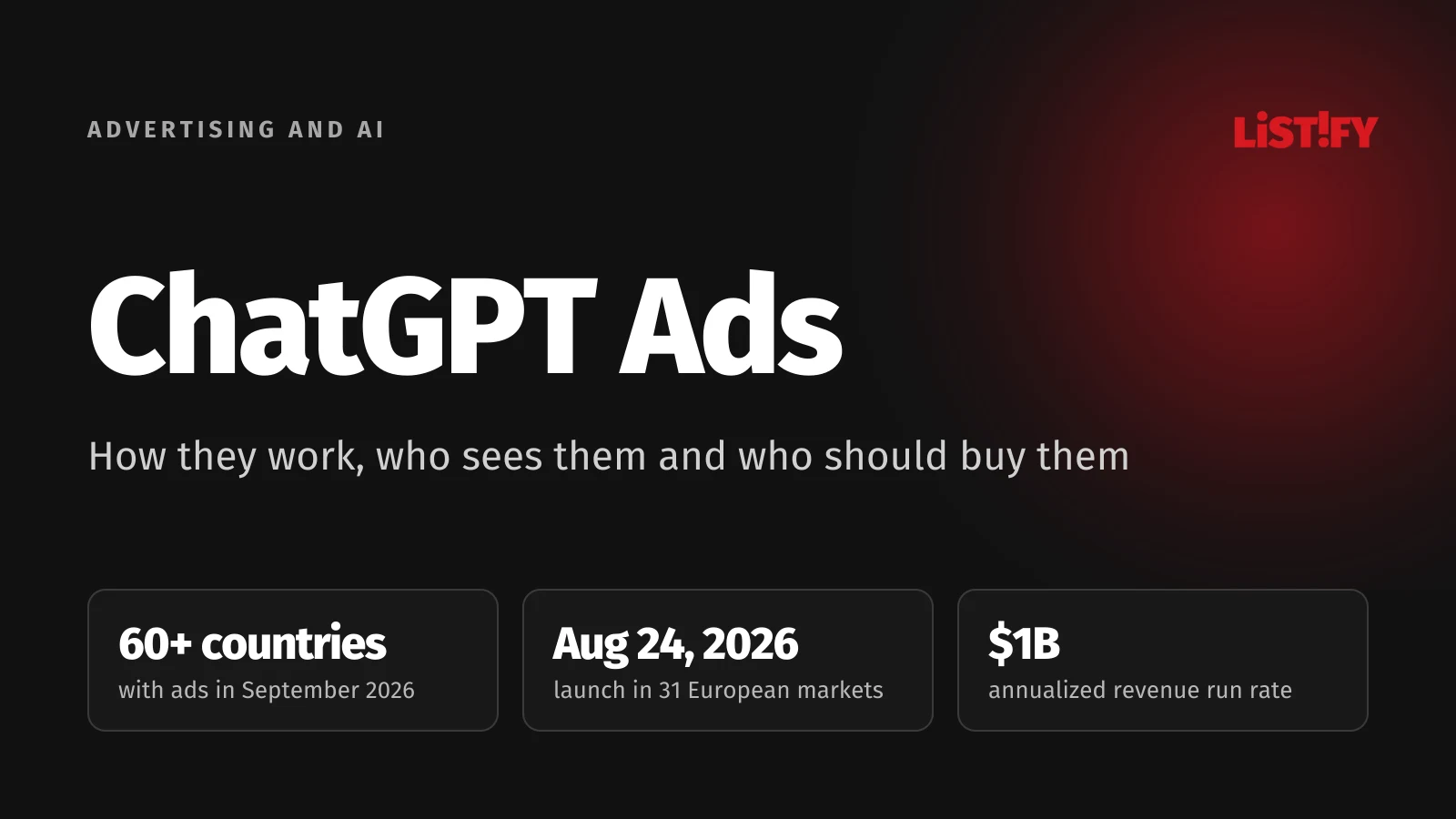
Ads only appear to users on the free plan and the low-cost Go plan. They’re labeled as sponsored, sit separately below the answer, and according to OpenAI don’t influence what ChatGPT says (OpenAI). In under 200 days, the ad business reached a $1 billion annualized revenue run rate, with tens of thousands of advertisers on board (OpenAI).
For businesses, this is a new ad channel that works differently from Google or Meta. There are no keywords, advertisers can’t see what people asked, and early campaign results are far from spectacular. If you’re thinking about getting started, it pays to know what you’re getting into.
01How it started: from a US test to 60 countries
In January 2026, OpenAI published the principles it would follow for advertising, and in February it began testing ads. Its main reason is straightforward: keeping the free version running for hundreds of millions of people costs a huge amount of money, and ads are meant to help pay for it (OpenAI).
| Date | What happened |
|---|---|
| Jan 16, 2026 | OpenAI publishes its principles for advertising in ChatGPT |
| Feb 9, 2026 | US test begins for logged-in adult users on the Free and Go plans |
| Mar 26, 2026 | Expansion to Canada, Australia and New Zealand announced |
| May 2026 | Self-serve Ads Manager with cost-per-click bidding opens to US businesses |
| Jun 6, 2026 | Ads go live in the UK |
| Jun 22, 2026 | Launch in Japan and South Korea |
| Aug 17, 2026 | Launch in Brazil and Mexico |
| Aug 24, 2026 | Launch in 31 European countries |
| Aug 29, 2026 | Launch in India |
| Aug 31, 2026 | Self-serve Ads Manager available across all 31 European markets; rollout to the Middle East and North Africa begins |
| Late Aug 2026 | Ad revenue passes a $1 billion annualized run rate |
| Sep 23, 2026 | Expansion to Southeast Asia and Taiwan, bringing the total past 60 countries |
That’s a remarkably fast rollout for an ad platform. In seven months, ChatGPT Ads went from one market to more than sixty, self-serve buying included.
- Feb 9: US1
- April: Canada, Australia, New Zealand4
- Jun 6: UK5
- Jun 22: Japan, South Korea7
- Aug 17: Brazil, Mexico9
- Aug 24: 31 European markets40
- Aug 29: India41
- From Aug 31: Middle East, N. Africa56
- Sep 23: Southeast Asia, Taiwan63
Cumulative, by launch date. The Middle East and North Africa (15 countries) have been rolling out since Aug 31 and are counted at once. OpenAI says “more than 60 countries”. Sources: PPC Land, OpenAI.
02What ChatGPT ads look like
An ad appears below ChatGPT’s answer as a separate card labeled “Sponsored.” You can’t pay to get into the answer itself (OpenAI).
There are three formats so far: a standard chat card, a product ad generated from a product feed, and a product carousel. There’s no video (Sprites). Product ads are built automatically from your catalog, and OpenAI supports up to a million products per advertiser (Stella Rising).
Here’s how it looks in practice: someone asks ChatGPT what to cook for a dinner party and gets a normal answer with ideas first. Below it, there might be a labeled offer from a grocery store, such as a meal kit with a price and prep time. That’s exactly the example OpenAI uses in its announcement (OpenAI).
03Who sees ads and who doesn’t
| ChatGPT plan | Ads |
|---|---|
| Free | Yes |
| Go (cheapest paid plan) | Yes |
| Plus | No |
| Pro | No |
| Business, Enterprise, Edu | No |
Other rules that apply everywhere:
- Adults only. Ads aren’t shown to accounts where the user says, or OpenAI predicts, that they’re under 18.
- No ads near sensitive topics. Ads won’t appear in conversations about health, mental health or politics (OpenAI).
- You can go ad-free. Anyone who doesn’t want ads can upgrade to Plus or Pro. According to OpenAI, free users can also turn ads off in exchange for fewer free messages per day (OpenAI).
There’s an important catch for advertisers here. Free users make up the vast majority of ChatGPT’s audience, so the reach is huge. But the people who use ChatGPT for work every day, such as specialists, managers and business owners, often pay for Plus or Business and never see ads. For B2B, that’s a real limitation.
04Where ChatGPT ads are available
As of September 27, 2026, ChatGPT Ads are available in more than 60 countries (OpenAI).
| Region | Countries | Since |
|---|---|---|
| North America | US, Canada | US since February 2026, Canada since spring 2026 |
| Oceania | Australia, New Zealand | Spring 2026 |
| UK | United Kingdom | Since June 2026 |
| Latin America | Mexico, Brazil | August 2026 |
| Europe | All 27 EU countries plus Iceland, Liechtenstein, Norway and Switzerland | August 24, 2026 |
| Asia | Japan, South Korea, India | Japan and Korea since June, India since late August 2026 |
| Middle East and North Africa | 15 countries, including Israel, Saudi Arabia, the UAE, Egypt and Turkey | Rolling out since August 31, 2026 |
| Southeast Asia | Indonesia, Malaysia, the Philippines, Singapore, Thailand, Vietnam, Taiwan | September 23, 2026 |
What’s different in Europe
Europe has stricter data protection rules, so ads there launched as contextual rather than personalized. They’re chosen based on what the current conversation is about, not on the user’s history (Giovanni Perilli). European advertisers could initially buy only through OpenAI’s Ads Solutions team, agency partners and technology partners. On August 31, OpenAI announced that self-serve Ads Manager was available across all 31 European markets (OpenAI).
05Rules and privacy: what advertisers can and can’t see
OpenAI built its ads around a handful of principles that it repeats in every announcement. They’re worth knowing, because they define what advertising in ChatGPT can and can’t do.
Ads don’t change the answer
According to OpenAI, ChatGPT’s answers are based on what’s most helpful to the user, and ads have no influence on them. Ads are always labeled as sponsored and visually separated from the answer (OpenAI). In other words, you can’t pay to have ChatGPT recommend you in its answer.
Advertisers don’t see conversations
Advertisers have no access to conversations, chat history, memories or personal details. They only get aggregate performance numbers, such as views and clicks (OpenAI). OpenAI also says it never sells customer data (OpenAI).
For marketers, that has a practical consequence: there’s nothing like Google Ads’ search terms report. You won’t find out exactly what people asked when your ad showed up.
How ads are chosen
Outside Europe, ChatGPT picks ads based on the topic of the current conversation, past chats and how the user has interacted with ads before. Someone researching recipes might see an ad for meal kits or grocery delivery (OpenAI). In Europe, only the current conversation is used at launch (see above).
What users can control
Users can hide an ad, give feedback, see why they were shown it, delete their ad data with one tap and change their personalization settings at any time (OpenAI).
Protection against scams
OpenAI says it’s deliberate about who it lets into the advertiser program and is building protections against scams and misleading ads. It also guards against targeting that’s too narrow (OpenAI). Expect business verification and category-based review when you sign up.
06For advertisers: how ChatGPT ads work
Setting up an account
You sign up at ads.openai.com. Before launching, you’ll go through advertiser verification, billing setup and landing-page checks, and some settings can’t be changed later, so choose them carefully (Space Ads).
If you’d rather not run the account yourself, you can go through OpenAI’s Ads Solutions team or major agency groups such as WPP, Publicis, Omnicom, Havas and dentsu (Adgully).
Targeting without keywords
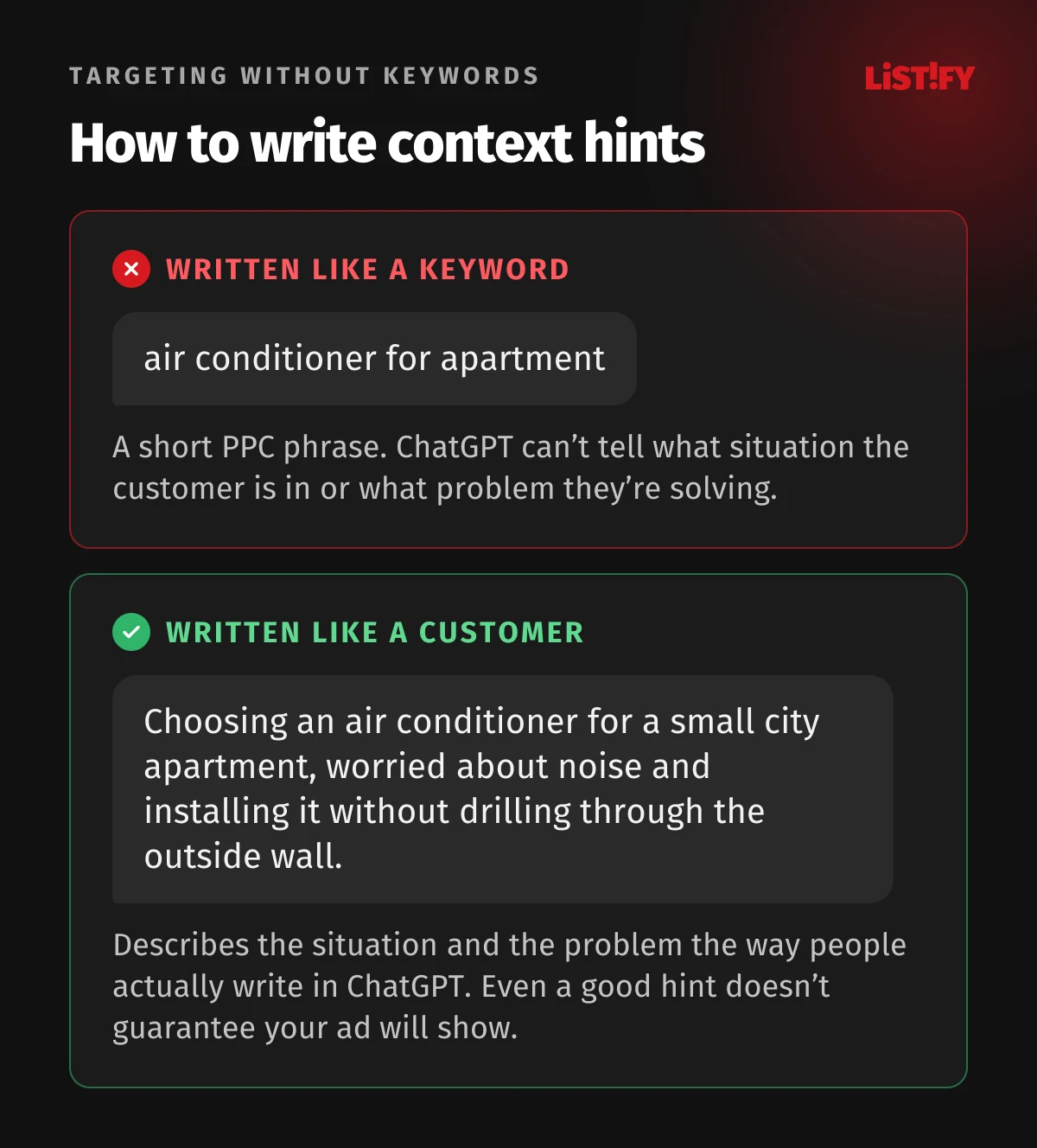
This is the biggest difference from Google Ads. ChatGPT Ads don’t use keywords. Instead, you write context hints: plain-language descriptions of the conversations, topics and buyer situations where your product is genuinely useful. The system then decides when to show your ad based on the conversation, your context hints, your landing page, and your ad’s title and copy (Sprites).
In practice, that means writing like a customer, not a PPC specialist. Instead of “air conditioner for apartment,” something like “choosing an air conditioner for a small city apartment, worried about noise and installing it without drilling through the outside wall” works better. Context hints don’t guarantee your ad will appear in a given conversation, though.
OpenAI has since added geo-targeting and custom audiences (OpenAI).
Buying models and pricing
| Model | You pay for | Best for |
|---|---|---|
| CPM | 1,000 impressions | Reach and brand awareness |
| CPC | A click | Website traffic |
| oCPC | A click, optimized for conversions | Sales, leads, sign-ups |
Prices are set by a relevance-weighted second-price auction, so the quality of your ad and landing page matters as well as your bid, much like Quality Score in Google Ads (Space Ads). OpenAI recommends a starting maximum bid of $3 to $5 per click, and the default maximum CPM is $60 (MRKT Correct). There’s no minimum total spend, but there is a daily minimum: $25 for USD-billed accounts and €15 for accounts billed in euros (Travi, TruCommerce).
It didn’t start out that way. Early on, advertisers faced high minimum commitments. The minimum spend dropped to $50,000 and was then removed entirely when self-serve Ads Manager opened to all US advertisers in May 2026 (The Keyword). Actual CPMs also fell from the $60 default to around $25 over roughly the first ten weeks as inventory grew (MRKT Correct).
- Default maximum$60
- Actual after ~10 weeks$25
According to MRKT Correct, September 2026.
Before you launch, work out what the cost per click does to your margins. At $3 to $5 per click and a 2% conversion rate, each order costs you $150 to $250. For low-margin products, that doesn’t add up yet.
- 1% conversion$3 per click: $300$5 per click: $500
- 2% conversion$3 per click: $150$5 per click: $250
- 3% conversion$3 per click: $100$5 per click: $167
- 5% conversion$3 per click: $60$5 per click: $100
Cost per click divided by conversion rate, at OpenAI’s recommended $3 to $5 starting bid. Excludes margin and other costs.
Measurement
Conversions are tracked through the OpenAI Pixel or the Conversions API, and third-party measurement integrations are available too (OpenAI). Add UTM parameters to your URLs so you can separate ChatGPT Ads traffic in Google Analytics.
Early results
OpenAI calls it a success: tens of thousands of advertisers and more than $1 billion in annualized revenue (OpenAI). Its March update said the test showed no impact on user trust and low ad dismissal rates (OpenAI).
Independent data is more sobering. According to EMARKETER, ChatGPT ads average a click-through rate of about 0.9%, compared with 6.64% for Google Search according to WordStream (Sprites). And PPC Land notes that there’s almost no public performance data yet outside the US and the UK (PPC Land).
- ChatGPT ads average (EMARKETER)0.90%
- Google Search ads (WordStream)6.64%
Averages from EMARKETER and WordStream, as cited by Sprites.
07Is it worth it? Who should try it now, and who should wait
For now, ChatGPT Ads work best as a way to reach people while they’re researching and comparing options, not as a replacement for search ads. The upside is being part of the decision before your competitors are. Don’t expect a fast return just yet.
| Business type | Recommendation | Why |
|---|---|---|
| Online store with a solid feed and healthy margins | Test it | People really do choose products in ChatGPT, and the product formats fit that |
| B2C services (travel, home, education) | Test it | Planning and comparison conversations are exactly what context hints describe |
| B2B and SaaS | Wait, or test for awareness only | Decision-makers often use paid plans that don’t show ads |
| Low-margin products | Wait | At $3 to $5 per click, margins disappear fast |
| Healthcare | Limited | Advertisers can qualify after category review, but ads don’t appear in health conversations |
| Politics | Not possible | Political ads are banned in ChatGPT |
At the $25 daily minimum and $3 to $5 per click, you’d get five to eight clicks a day, so a test that gives you readable results is closer to $1,000 to $2,000 a month (Sprites).
What to do before you spend your first dollar
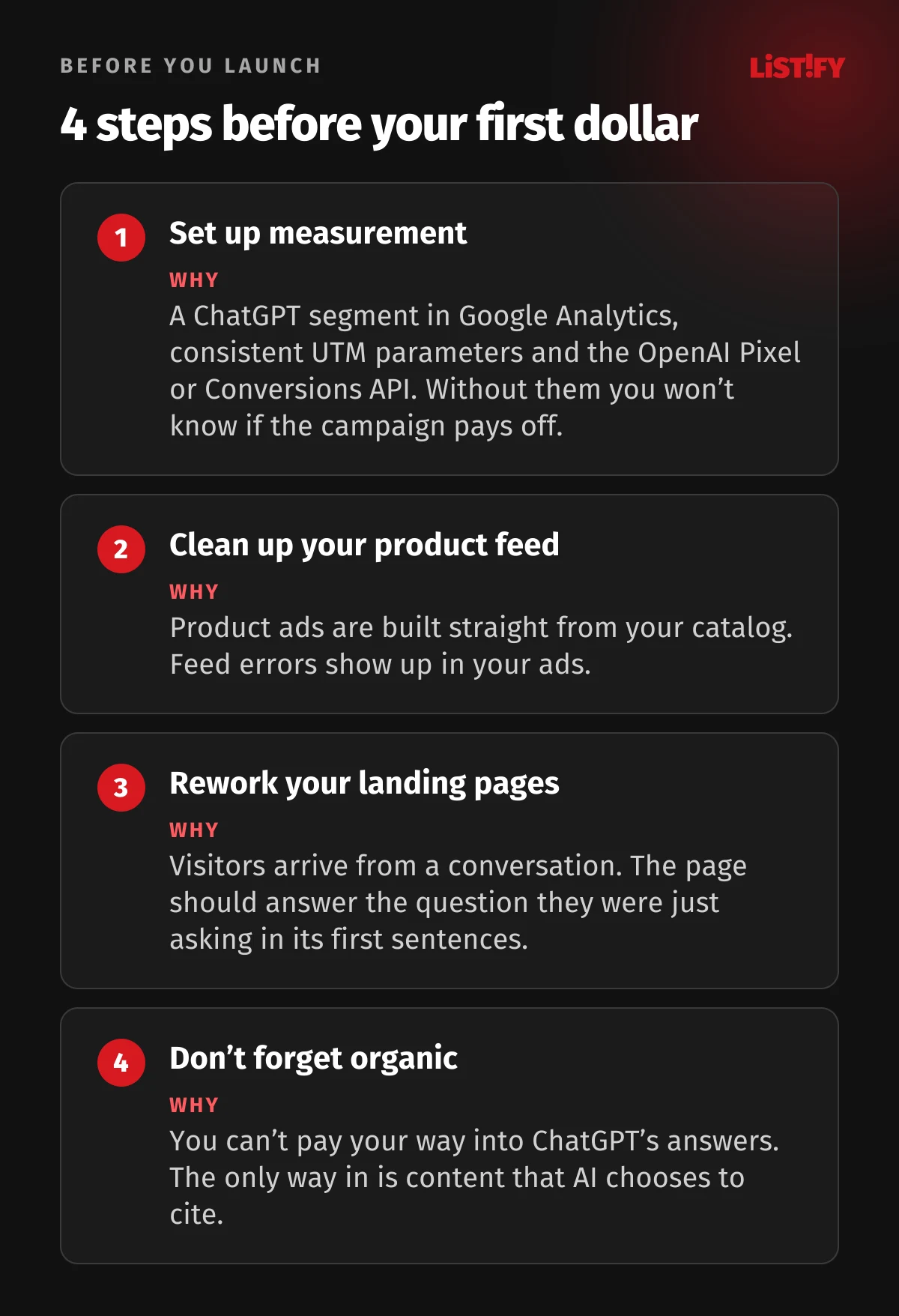
- Set up measurement. A segment for ChatGPT traffic in Google Analytics, consistent UTM parameters, and the OpenAI Pixel or Conversions API.
- Clean up your product feed. Product ads are built straight from your catalog. Missing attributes, vague names or broken images show up directly in your ads.
- Rework your landing pages. Visitors arrive from a conversation, not a search results page. The page should answer the question they were just asking in its first couple of sentences.
- Don’t forget organic recommendations. You can’t pay your way into ChatGPT’s answers. The only way in is content that AI chooses to cite: a fast, clear and trustworthy website that answers your customers’ questions. We help with content and technical SEO as part of our online marketing service.
Want to compare the AI assistants themselves? See our best AI models of September 2026 comparison and our guides to OpenAI’s latest model GPT-6 Astra, Anthropic’s Claude Fable 5.1 and Google’s Gemini 3.8 Flash.
08FAQ
Does ChatGPT have ads?
Yes. Since February 2026, ChatGPT has shown ads to users on the Free and Go plans. As of September 2026, they run in more than 60 countries.
How do I get rid of ads in ChatGPT?
Plus, Pro, Business, Enterprise and Edu plans are ad-free. According to OpenAI, free users can also turn ads off in exchange for fewer messages per day.
Do ads affect ChatGPT’s answers?
According to OpenAI, no. Ads are labeled as sponsored, shown separately below the answer, and you can’t pay to get into the answer itself.
Can advertisers see my conversations?
No. Advertisers have no access to conversations, chat history, memories or personal details. They only get aggregate numbers on views and clicks.
How do I advertise on ChatGPT?
Sign up for self-serve Ads Manager at ads.openai.com, available in most markets where ads run. You can also go through OpenAI’s Ads Solutions team or its agency partners.
How much do ChatGPT ads cost?
Prices are set by auction. You can pay per impression, per click, or per click optimized for conversions. OpenAI recommends starting with a maximum bid of $3 to $5 per click. There’s no minimum total spend, but USD-billed accounts have a $25 minimum daily budget.
How does targeting work in ChatGPT ads?
Without keywords. Advertisers describe the situations and topics where their product is useful, and the system picks ads based on the conversation. In Europe, ads launched as contextual only, without personalization.
Do ads appear on every topic?
No. Ads don’t appear in conversations about health, mental health or politics, and they aren’t shown to users under 18.
09Sources
We checked availability, rules and pricing in September 2026:
- OpenAI: Our approach to advertising and expanding access
- OpenAI: A milestone in expanding access to AI
- OpenAI: Testing ads in ChatGPT
- OpenAI: ChatGPT Ads expands across Europe
- OpenAI: ChatGPT Ads expands to Southeast Asia and Taiwan
- PPC Land: OpenAI gains 7 Asian markets for ChatGPT ads
- Adgully: OpenAI expands ChatGPT Ads into seven Asian markets
- Tech Insider: ChatGPT Ads rollout 2026
- Giovanni Perilli: ChatGPT Ads in Europe
- PPC Land: ChatGPT ads pass $1bn run rate
- TruCommerce: ChatGPT Ads in Europe
- Sprites: ChatGPT Ads, the complete guide for marketers
- Stella Rising: Two Doors Into ChatGPT Ads
- Space Ads: ChatGPT Ads, what they are, how to buy them and what they cost
- Travi: ChatGPT Ads in 2026, Cost, Targeting and Setup
- The Keyword: ChatGPT Ads
- MRKT Correct: ChatGPT Ads Manager guide