Use AI for social media content without losing your voice
AI can help shape a post, but it cannot supply your company’s actual experience. Generic content often begins with generic inputs: a broad topic, no useful evidence and an instruction to sound engaging. Give the workflow real material and a point of view before asking for polished copy.
Use AI to organize notes, explore angles and adapt an approved idea to a format. Keep the observation, argument and final judgment with the people who know the business. Faster production is useful only when the resulting post gives the audience something worth reading.
Consider a bicycle repair shop preparing spring maintenance posts. A vague request for cycling tips produces familiar advice. Notes from the mechanic about three checks customers overlook can become a useful carousel, a short demonstration and a practical reply to a recurring question.
01Collect the material only your team can provide
Build a small source library from real work: approved product facts, demonstrations, repeated support questions, staff explanations and documented project decisions. Include what you learned and where the advice applies. A specific constraint often makes a post more useful than an ambitious headline.
Interview the subject expert with concrete questions. What did the customer misunderstand? Which choice changed the result? What would you check first? Preserve the rough answer before editing. Spoken detail and ordinary vocabulary can reveal the brand’s voice more clearly than a list of abstract adjectives.
Keep permissions and confidentiality with the material. An anonymized note can still reveal a customer through a distinctive project or image. Use approved examples or create a clearly illustrative scenario rather than quietly converting private support conversations into public posts.
Separate facts from ideas in the brief. Mark a product capability as confirmed, a suggested angle as exploratory and a numerical result as requiring its source. This stops the model from treating a brainstorming note as an established achievement.
Choose one audience problem for each post. A technician, a first-time buyer and an operations manager need different levels of explanation. Content becomes generic when it tries to address all of them without saying what decision any one reader can make.
02Describe the voice through examples and boundaries
Give the model several approved pieces of writing and explain the features you want to retain: direct openings, concrete nouns, short explanations and a measured claim. Do not simply request professional and friendly, since those words leave most editorial decisions undefined.
Include examples of phrases your team would reject and why. The problem may be inflated claims, unnecessary excitement, stock introductions or a tone that sounds distant from the people doing the work. A reason is more useful than a long arbitrary banned-word list.
| Input | Useful instruction | Human decision |
|---|---|---|
| Expert notes | Use only the supplied facts; flag gaps | Which observation matters to the audience |
| Approved voice examples | Keep their directness and level of detail | Whether the draft sounds like the brand |
| Product documentation | Preserve limitations and conditions | Whether the claim is accurate and current |
| Format brief | Adapt one idea to a carousel or short script | Whether the format makes the idea clearer |
| Draft review | Identify vague or unsupported passages | What is ready to publish |
Describe the brand’s perspective as a decision rule. A repair shop might favor explaining when a part can be repaired rather than replaced. A software team might discuss operating responsibilities alongside launch features. A useful perspective guides substance, not just punctuation.
Leave room for channel and author differences. A founder’s post can sound more personal than a product account update while sharing the same standards for accuracy. Do not flatten everyone into identical sentence lengths or mandatory catchphrases.
03Use a brief that contains the argument
A workable brief contains the audience, problem, main point, evidence, limitations, format and desired next action. Tell the model which source material it may use and what it must not invent. Ask it to identify missing information rather than fill the gaps with plausible detail.
For the bicycle shop, the argument could be: a noisy drivetrain does not always mean the chain needs replacement; explain the checks the mechanic uses before recommending work. Attach the mechanic’s approved notes and the relevant product facts. Do not request a dramatic customer story unless one is documented and cleared.
Ask for several distinct angles before several polished drafts. One angle might explain a misconception, another show a decision process and a third answer a frequent question. Select the useful idea before spending review time on ten variations of the same generic opening.
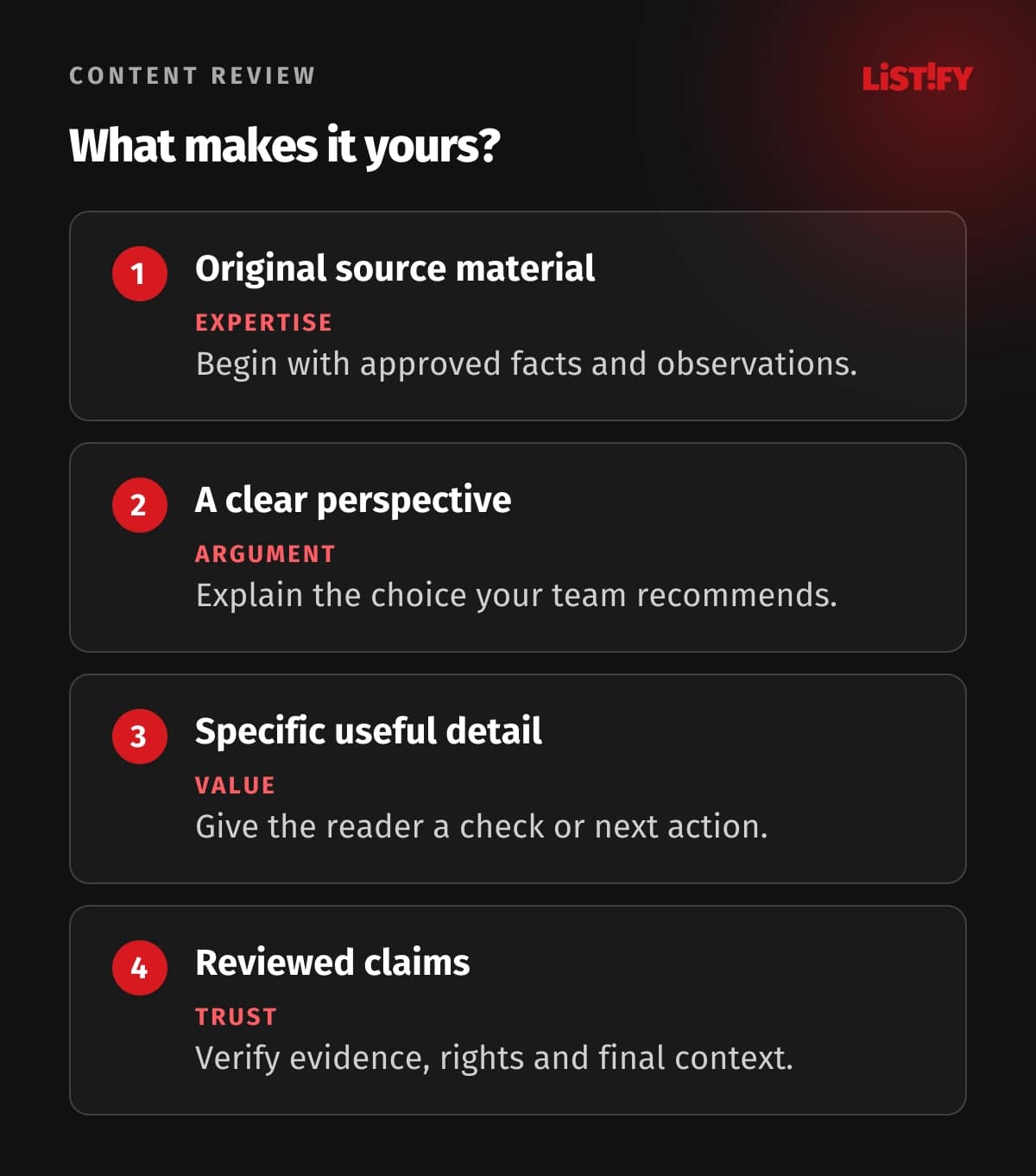
Use a bounded instruction such as: draft a short carousel outline from these notes, keep the repair conditions, include one concrete check per slide and mark unsupported statements. That gives the output a reviewable shape without promising that prompt wording alone guarantees correctness.
Treat external text and uploaded material as source data, not as authority to change your publishing rules. A copied document can contain irrelevant instructions. Keep the approved brief and reviewer responsibilities separate from whatever content the tool reads.
04Edit the substance before polishing the sentences
Read the draft for a useful claim first. Can you identify what the reader learns or can do? If the whole post amounts to quality matters or know your audience, request the missing concrete observation from the team rather than generating a more elaborate version of the same thought.
Replace broad claims with actual detail that you can support. Instead of a promise that a process saves time, explain which repeated step it removes and what still requires review. Specificity is a discipline of evidence, not an instruction to invent a statistic.
NIST’s Generative AI Profile identifies risks including confabulation and information integrity. Use that risk context to justify checking facts and attribution; fluent language is not evidence that the underlying claim is correct.
Check every product fact, date, comparison and quotation against its source. A model can alter a caveat while shortening a sentence. If the caveat affects a buying decision, preserve it even when the post becomes less punchy.
Read the final version aloud. Remove repeated structures, stock transitions and excessive promises. Keep the natural words an expert would use with a customer. The community strategy guide connects the post to a broader relationship with the audience.
Maintain a short editing rubric and record common failures. Future briefs can prevent a repeated issue, but the final review should stay attached to the actual output. Approval of the prompt is not approval of every draft it produces.
05Use visuals and synthetic media honestly
Choose the visual based on the information. A real demonstration can show a product action; a diagram can explain a workflow; an illustration can express a concept. An attractive synthetic image is less useful when it makes the product, venue or result look different from reality.
Keep brand assets, layout rules and typography consistent. Use AI-created material as an asset inside the design process where appropriate, then inspect the exported post for small-screen readability, distorted details and misleading depictions. A generated mockup should not be presented as a shipped interface.
YouTube’s disclosure guidance distinguishes realistic generated or meaningfully altered content from routine production assistance and minor edits. Review the actual case and current upload controls when producing video. Do not generalize one platform’s rule to every social channel.
Meta’s explanation of AI labels describes labeling based on signals and disclosures. Check the publishing platform’s current requirements for your content and preserve relevant provenance rather than designing around avoiding a label.
Review rights and permissions for photographs, music, voices and recognizable people. A tool’s ability to generate a likeness does not establish permission to use it as an endorsement. Keep real customer quotations separate from illustrative copy and do not manufacture a testimonial.
For advertising aimed at US consumers, FTC advertising guidance explains truthful claims and substantiation. Other markets have their own applicable rules. AI-assisted production does not remove responsibility for what the audience is led to believe.
06Build a repeatable editorial workflow and measure value
Use a simple sequence: gather approved material, choose the angle, generate a bounded draft, review the substance, design the asset and approve the final post. Name the reviewer and keep the approved version distinct from earlier drafts.
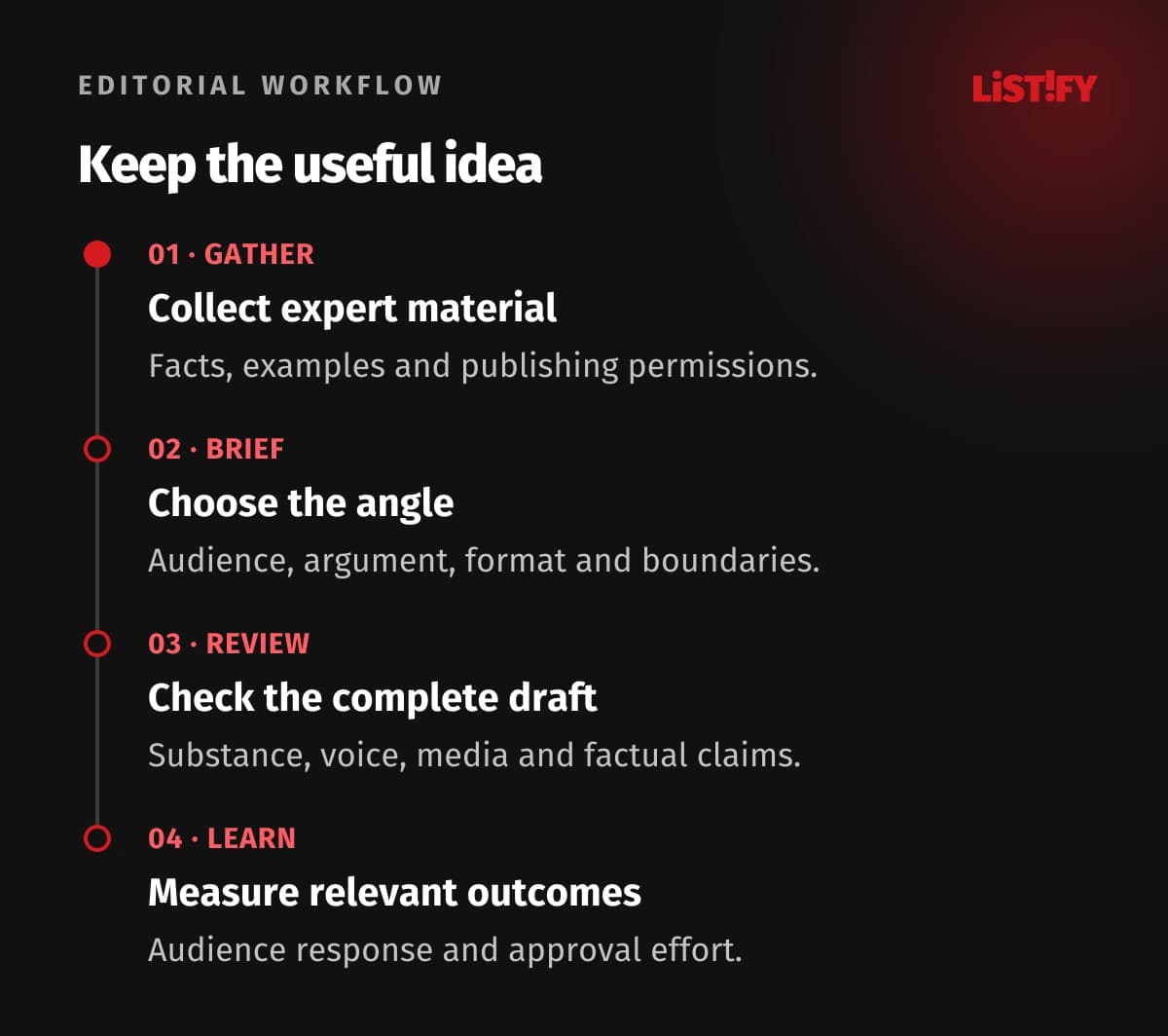
Batch the steps where it helps. An expert can record several answers in one session, and a writer can adapt one approved explanation into several formats. Avoid automatically posting every generated variant; an idea reused too often can become repetition even if each caption is technically different.
Decide what success means for the content’s purpose. An explanation may prompt relevant questions or visits to a guide; a product demonstration may support qualified inquiries. Likes alone do not establish that the intended audience understood the offer or took the useful next step.
Use the social measurement guide for related reporting context. Compare similar content and record important changes in distribution. A post boosted with paid reach should not be judged against an unpromoted post as if the conditions were identical.
Measure review effort as well as generation speed. If every draft needs a full rewrite, improve the source library and brief. The useful efficiency gain is approved content produced with less unnecessary work, not merely more words created in a minute.
07Questions about AI-assisted social content
How do we make an AI draft sound like our brand?
Supply approved examples, real expert material and clear editorial boundaries. Select a useful argument and edit the substance. Asking for authenticity without giving the tool your actual perspective usually produces another familiar writing style.
Can we generate a month of posts at once?
You can draft a batch from approved material, then review each item and the sequence. Check freshness, repetition and factual conditions before scheduling. A completed batch is not permission to ignore later product or business changes.
Do AI-assisted posts always need an AI label?
Requirements depend on the platform and the content. Realistic synthetic or meaningfully altered media can be treated differently from ordinary drafting assistance. Check current rules for the specific post rather than applying one blanket answer.
Can AI write customer testimonials?
It can help edit an approved real quotation without changing its meaning. Do not invent a customer, quotation or result and present it as genuine evidence. Use clearly identified illustrative scenarios when no publishable case exists.
Should we use AI-generated product pictures?
Only when the depiction serves the purpose and stays accurate about the offer. Inspect details and distinguish concepts or mockups from actual products. Real photography or a clear diagram may communicate a practical feature more reliably.
What belongs in the final review?
Facts, claims, quotations, rights, confidentiality, brand voice, links and the visual impression. Check the final exported asset as well as the caption. Shortening or redesign can change what the audience understands.
How do we tell whether the workflow helps?
Track the effort required to produce approved posts and the audience outcomes relevant to their purpose. Review quality and recurring corrections. More generated drafts or a temporary rise in likes alone does not establish useful progress.