Push notifications: design campaigns that earn a return visit
A notification can remind someone to finish a useful task or make them wish they had never installed your app. The difference starts before the copy: decide who needs the message, what has changed, how long it remains useful and what would justify interrupting that person.
Treat each retention campaign as a product decision with an owner, an eligibility rule and an experiment. A successful campaign helps users return to something they value. A temporary rise in notification opens is too narrow a definition of success.
Consider a language-learning app. A reminder about a lesson the learner scheduled has a clear purpose. Sending the same encouragement to every account each morning ignores people who have already studied, changed their schedule or stopped using reminders. Campaign design should resolve those differences.
01Start with a useful event and an eligible audience
Write a one-sentence hypothesis before configuring a campaign: learners who asked for a study reminder will complete more planned lessons when reminded shortly before their chosen time. This specifies the audience, trigger and intended outcome. It is more actionable than a broad instruction to increase engagement.
Make eligibility depend on a meaningful state, not simply on inactivity. Has the person started the relevant task? Is there a saved item, a real deadline or a requested update? Does the account still have access? An old signup date does not explain why someone would benefit from hearing from you today.
Separate the primary use cases. A delivery update supports an existing transaction. A scheduled habit reminder supports a preference. A promotion seeks another purchase. Combining them under one campaign calendar makes frequency, opt-out behavior and evaluation harder to understand.
| Message | Eligibility | Suppression rule |
|---|---|---|
| Requested reminder | A user selected a task and reminder time | Task completed, reminder paused or preference changed |
| Progress update | A tracked order or job changed state | State is unchanged or the message has expired |
| Return-to-task campaign | A relevant task remains unfinished | Task completed, account closed or experiment excludes user |
| Promotion | The recipient is eligible for that marketing message | Marketing disabled, offer unavailable or contact budget used |
Include an explicit reason to exclude someone. Suppression is part of targeting, not cleanup after the send. A completed task, a support incident or a recently rejected offer can be more relevant than membership in a broad audience segment.
02Ask for permission when its value is clear
Show the benefit close to the action that creates it. A user following a parcel understands a request for delivery alerts. A blank home screen followed by a system permission dialog asks them to agree before they know what the app offers.
Android notification permission guidance describes the runtime permission for non-exempt notifications on Android 13 and later, including contextual requests and checking whether notifications are enabled. Handle denial and current settings as normal application states.
Offer a useful preference screen: reminders, account activity and promotional messages can have different controls. Explain what a category means in language the user recognizes. A switch labeled engagement is a description of your objective, not of what they will receive.
Apple App Review Guidelines require explicit opt-in for promotional or direct marketing push messages and an in-app method to opt out. Review the applicable platform rules and your jurisdiction before treating an operating-system permission as sufficient authority for every campaign.
Keep the product usable when optional reminders are declined. Repeated prompts, guilt-based copy and confusing controls weaken trust. Record preferences consistently across devices and ensure that a setting change reaches the sending system before the next eligible campaign.
03Give every campaign an interruption budget
Frequency caps belong at account level as well as campaign level. Three teams can each send a modest number of messages while collectively producing an unreasonable day for one user. A shared contact policy should resolve overlapping campaigns before they enter the delivery queue.
Choose a starting limit from the task and expected rhythm. A daily learning habit, a weekly report and an occasional restock update need different schedules. There is no defensible universal best number of pushes per week. Begin conservatively and change it based on outcomes and user preferences.
Quiet hours should use the intended recipient time zone and have a documented treatment for unknown zones and daylight-saving changes. If timing is essential, invite users to select it. Inferring a permanent local schedule from one device location can produce surprising results when they travel.
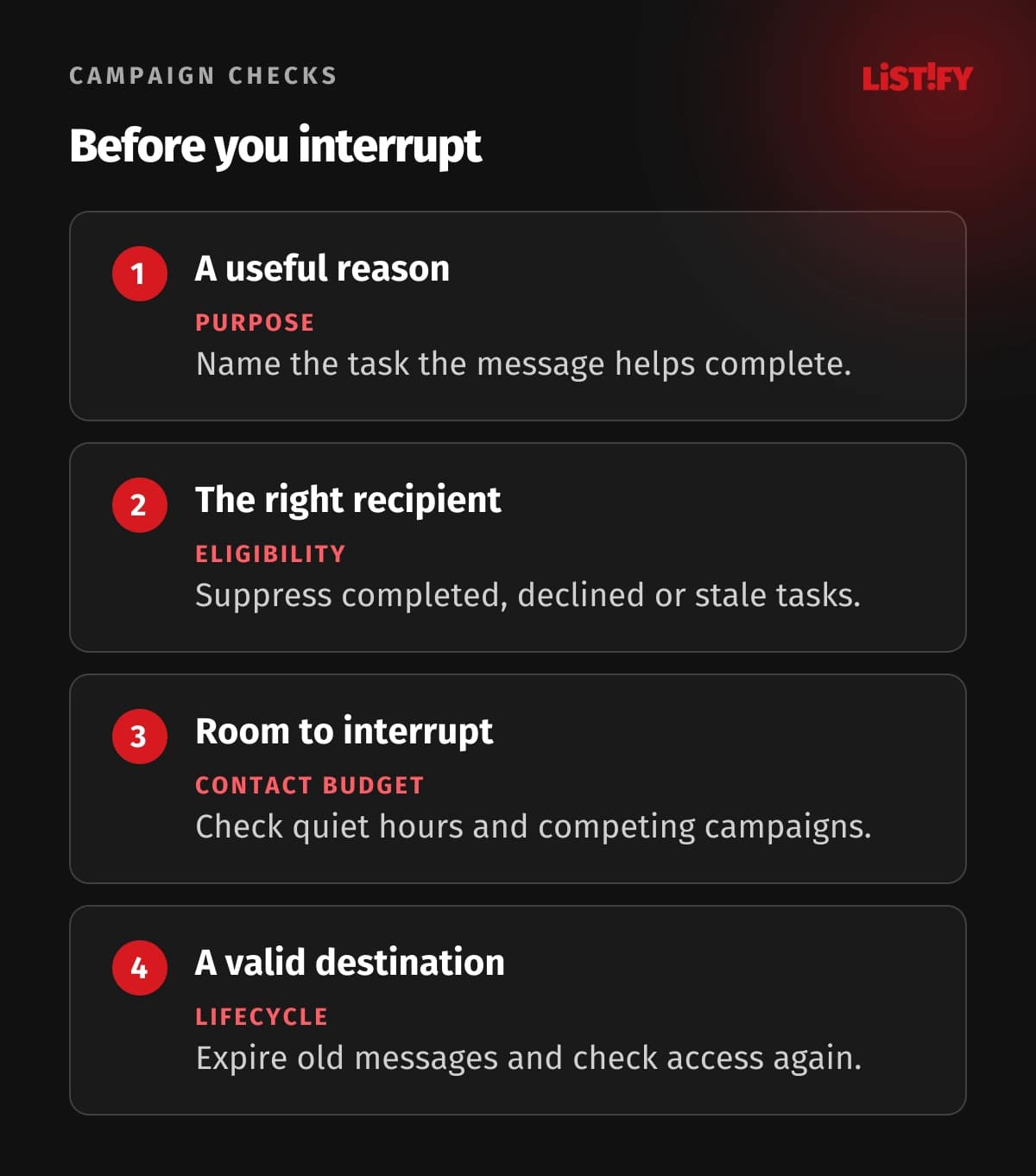
Prioritize campaigns when they collide. A useful order update may take precedence over a promotional reminder, but that priority should be an explicit product rule. Review it across channels so an email and a push do not repeat the same low-value request a few minutes apart.
Let users reduce interruption without abandoning the app. A digest, a less frequent schedule or a paused reminder can preserve a useful relationship. Make sure those choices control the real sending rules rather than only changing a label on the preferences screen.
04Expire stale messages and open the right task
A useful reminder can become misleading while it waits for delivery. Define expiration from the underlying event: a meeting invitation is no longer useful after the meeting starts, and a task-completion prompt is obsolete once the task is finished.
Firebase message lifespan documentation explains that messages may be delayed and describes time-to-live settings for Android and Web and APNs expiration for iOS. Set expiration deliberately instead of inheriting a default that outlasts the business event.
Recheck eligibility as close to sending as practical and again when the app opens. A queued message should not revive a canceled promotion. The destination should show the current state and explain an unavailable action calmly, without trapping the person in an error or an irrelevant home screen.
Deep links need account and authorization checks. A notification preview is not proof that the current device session may access the named record. Avoid sensitive details on a lock screen, and test logged-out sessions, account switching, old app versions and expired content.
Use a stable campaign identifier and event identifier to diagnose duplicate sends. Decide how retries, updated event states and multiple devices interact. The goal is a coherent user experience, not merely a delivery job that eventually reports success.
05Measure retained behavior against a control group
Track the path from eligible account to intended product action. Delivery acceptance, device delivery where measurable, opening and task completion describe different stages. Do not present a provider accepting a message as proof that a person saw it.
Define retention as a return to a meaningful action within a specified window. For a learning app that might be completing a lesson during the next planned study period. For a reporting app it could be reading and using the next report. A launch caused by a misleading alert is not automatically valuable retention.
Assign eligible accounts to a campaign group and a comparable holdout before sending. Randomization at account level avoids placing the same person in both groups through separate devices. Keep the underlying product experience as similar as the experiment permits.
Record the assignment separately from whether a notification was opened. Comparing openers with non-openers selects people by their subsequent behavior and cannot establish the campaign effect. Evaluate the intended assigned groups, then inspect delivery and opening as supporting diagnostics.
Agree on the measurement window, primary outcome and stopping approach before checking results. Repeatedly ending experiments as soon as a favorable number appears can create unreliable decisions. Low-volume apps may need a longer observation period or a narrower experiment, not a confident conclusion from a handful of events.
Use product instrumentation that records completion reliably. The mobile app security guide provides related implementation context for access and protected data. Treat experiment data with the same care as other account information.
06Set guardrails and a practical stop rule
Retention should improve without unacceptable costs. Review notification preference changes, complaints, duplicate incidents and delivery failures alongside the primary outcome. Uninstall signals can be incomplete or delayed, so describe what your measurement can observe instead of claiming precise individual attribution.
Choose campaign stop rules before rollout. Examples include a broken destination, messages reaching excluded accounts, sensitive information appearing in previews, or an adverse change exceeding the experiment threshold you agreed to investigate. Keep an owner who can pause sending and inspect queued jobs.
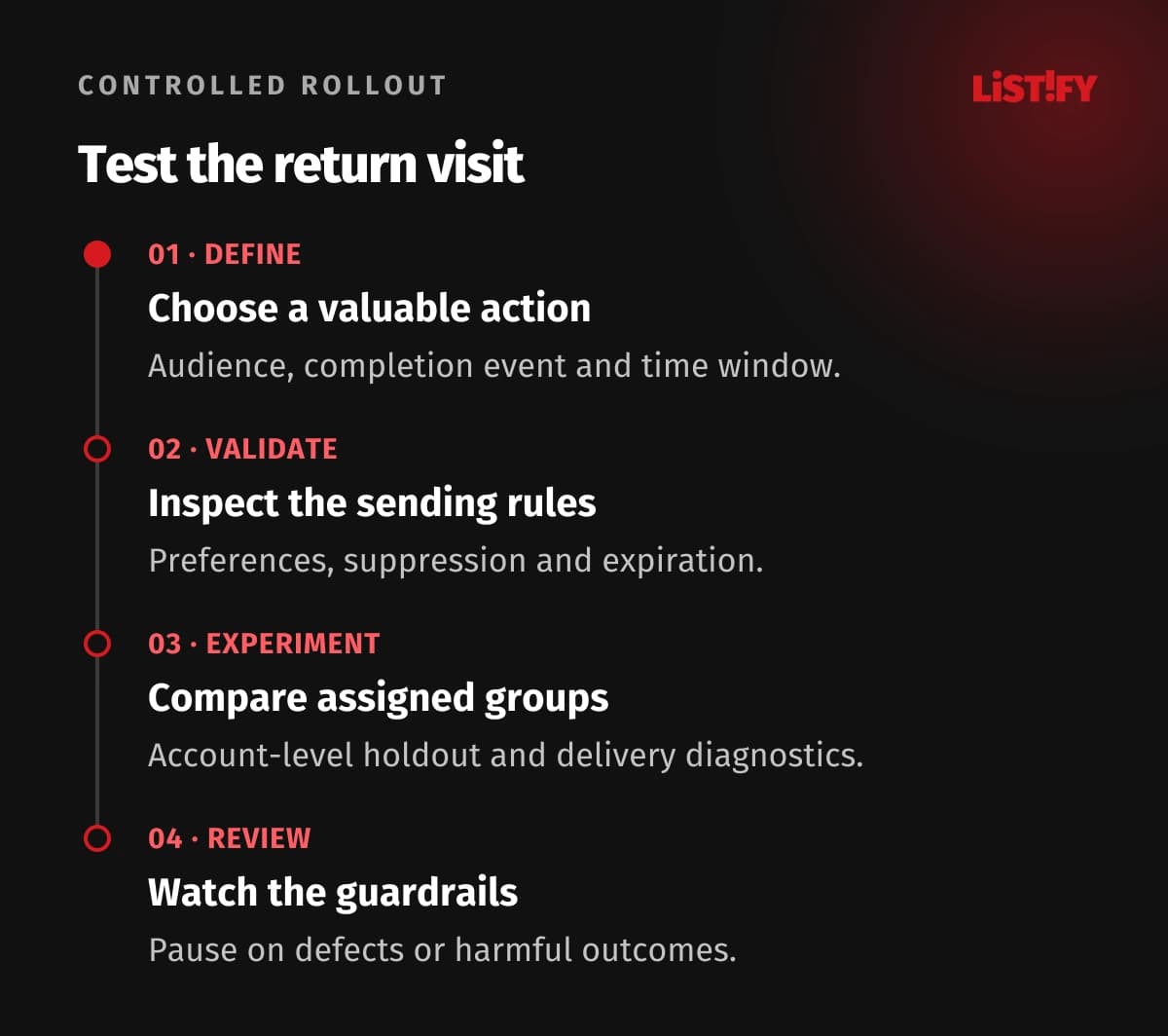
Start with a small eligible audience and inspect real examples of the event-to-message flow. Confirm that a task completed on another device suppresses the reminder, and that disabling the category stops later sends. Exercise daylight-saving changes and delayed delivery before expanding.
Keep a campaign registry containing the hypothesis, audience, contact budget, expiration, destination, experiment identifier and owner. Review old campaigns regularly. A reminder that was useful during onboarding can become background noise when the product or customer behavior changes.
When a campaign underperforms, inspect the product task as well as the message. A notification cannot repair a confusing lesson flow or a failed checkout. Improving the destination may create more value than changing the subject line again.
07Questions teams ask before a retention campaign
How many notifications should an app send?
Set frequency around the user task and preferences, then test a conservative starting policy. Apply a shared account-level budget across campaigns. A universal weekly quota ignores the difference between a requested reminder and an unsolicited promotion.
Should we ask for permission on the first launch?
Ask when the user can understand a concrete benefit. Following an order or setting a reminder creates a natural moment. Support declined permission and avoid making optional notifications a condition for using unrelated features.
Is an open rate enough to prove success?
No. Opening measures response to the message. Define the valuable action and compare assigned eligible groups over a suitable window. Include guardrails so a temporary rise in opens does not conceal preference changes or complaints.
Can we measure notification-caused uninstalls exactly?
Usually the available signals do not support exact individual attribution. Document their delays and coverage. Evaluate observable adverse outcomes and campaign groups without presenting incomplete device signals as a precise uninstall ledger.
What should happen when the offer expires?
Expire the queued message and suppress new sends. If someone opens an older notification, show the current state and a useful alternative. Never promise that an expired discount or unavailable item is still available.
Should a control group receive a different notification?
That depends on the hypothesis. To measure whether a campaign helps, a comparable no-campaign holdout is often appropriate. Comparing two copy variants answers which message works better, rather than whether sending is beneficial at all.
What is the first campaign to implement?
Choose a narrow task with clear user value, reliable completion data and controllable preferences. A requested reminder is easier to reason about than a broad win-back campaign. Establish expiration, suppression and a pause mechanism before expanding.