Link building in 2026: earn useful links without buying ranking promises
A business buys a package of backlinks and receives placements on unrelated pages that nobody would recommend to a customer. The report looks busy, but it provides little evidence of useful exposure or a durable search benefit. A better starting question is why another publisher would want to reference your page.
Links help people discover and navigate information, and they are part of how search engines understand the web. That does not make every link a useful investment. Relevance, editorial purpose, destination quality, and the way a placement is obtained all matter.
For a small business, link building should fit the work you can actually sustain. A maintained industry resource, a relevant collaboration, or a clear expert contribution can make more sense than a monthly quota of placements. There is no reliable package that guarantees a particular search position.
01Start with a page worth referring to
Choose a customer or professional question your business can answer well. It might be a practical checklist, a carefully explained comparison, an original dataset with its method, a useful calculator, or a documented technical solution. A sales page can also earn a reference when it genuinely serves the reader's task.
Make the contribution specific. A generic article assembled from familiar advice gives an editor little reason to link. Explain what you know from real work, what evidence supports it, and where the limits are. Do not invent research, customer outcomes, or expertise to make the resource seem more authoritative.
Keep the destination usable: clear title, understandable content, accessible presentation, and an appropriate next step. If the information is maintained, show relevant dates and sources. A resource can attract attention once and still become a poor recommendation when its data or instructions grow stale.
Google's SEO starter guide discusses helpful content, discoverability, and promoting a site appropriately. Treat promotion as a way to reach a relevant audience, rather than assuming that publishing something valuable automatically means the right people will find it.
02Look for an editorial reason in the right context
An industry publication may need a practical expert explanation. A partner may need to describe an integration. A professional association may maintain a genuinely useful member or supplier resource. A local organization may reference an event or service that matters to its audience. The link should help that audience understand or do something.
| Approach | Reason a link could be useful | What to review |
|---|---|---|
| Original resource | Adds evidence or a practical answer to a relevant page | Method, accuracy, maintenance and audience fit |
| Expert contribution | Provides a specific explanation the publisher needs | Actual expertise, editorial control and any compensation |
| Real partnership | Explains a working relationship, service or integration | Truthful description and relevance beyond link exchange |
| Relevant directory or association | Helps users find appropriate organizations | Editorial standards, audience and legitimate purpose |
| Paid promotion or sponsorship | Reaches an audience through a commercial placement | Clear disclosure and appropriate link qualification |
Keep outreach relevant and personal enough to demonstrate the connection. Explain which part of a publisher's work your resource helps and leave the editorial decision with them. Avoid mass messages that merely substitute a site name into a request for a backlink.
Respect permissions and communication rules for the markets involved. This is an editorial planning process, not authorization to send unsolicited messages or publish on another organization's behalf. A useful relationship is easier to maintain when the recipient can decline without pressure.
03Avoid practices whose main purpose is ranking manipulation
Google's current spam policies describe link spam, including links bought for ranking purposes, excessive exchanges, automated link creation, and low-value placements. Review the actual supplier method rather than accepting a reassuring name for the package.
Guest contributions are not automatically wrong, but an arrangement built around optimized anchors and paid ranking credit can create a different issue. Ask why the publication wants the content, what editorial work occurs, and what the reader gains. A useful article should not exist merely to hide a link purchase.
Likewise, a real partner reference differs from a large set of cross-linking pages created only for search manipulation. A legitimate directory differs from an unrelated collection of sites selling entries to anyone. The category label does not settle the quality of the individual arrangement.
Be cautious about repurposed expired domains, fabricated publisher identities, hidden placements, and large volumes of nearly interchangeable pages. An attractive authority score or an old domain age cannot explain what audience the current page serves.
04Treat sponsorship and paid links transparently
Advertising and sponsorship can be legitimate ways to reach an audience. They should be assessed as commercial promotion, with truthful representation, relevant disclosure, and appropriate search-related link treatment. Payment does not need to be disguised as an independent editorial recommendation.
Google's outbound-link guidance identifies sponsored for paid placements and ugc for user-generated contexts; nofollow can apply where other values do not fit. Its spam policy also recognizes appropriately qualified advertising links. Review the specific implementation rather than promising a paid link that passes ranking credit.
Keep advertising disclosure separate from the HTML attribute. A technical relation value is not necessarily visible to the audience and does not resolve every applicable advertising or endorsement requirement. Jurisdiction, platform rules, and the representation itself need review.
Judge a sponsored placement through the intended audience and commercial outcome. A qualified link may still produce relevant referrals or awareness. Do not dismiss it simply because it is unsuitable for a ranking-credit sales pitch, and do not invent a guaranteed search benefit to justify its price.
05Review suppliers beyond their authority metrics
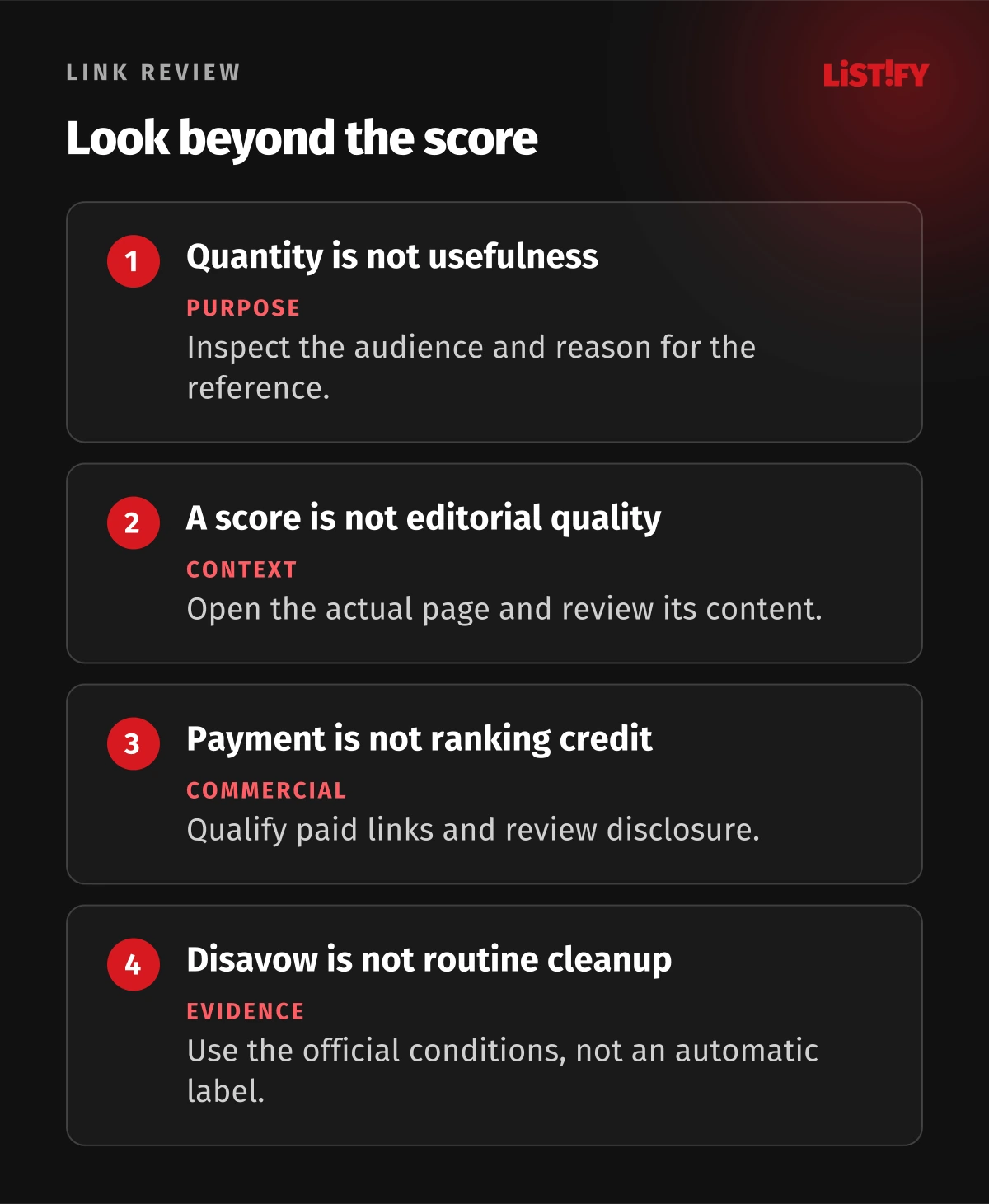
Ask for representative placements and an explanation of how they are obtained. Open the pages. Inspect the surrounding content, current audience, topics, publishing pattern, sponsorship treatment, and destination. A report containing only domain names and scores hides the information needed to assess the work.
Third-party authority metrics are estimates from their own tools. They are not Google's approval or a promise of ranking impact. Use them, if useful, as one input alongside direct inspection and the purpose of the placement.
Agree what the supplier may do and what requires approval. Include outreach representation, content accuracy, rights, paid arrangements, link qualification, reporting, and access to your systems. Avoid a contract that rewards volume while leaving methods unspecified.
For a global business, review the actual language and market. A page in a country you do not serve may still be useful for a particular audience, but that needs an explanation. An unrelated foreign-language placement should not be presented as relevant simply because a tool reports a high score.
Define how you will respond if a placement changes or disappears. Publishers can edit pages, move URLs, or close. A reasonable operating record helps you distinguish ordinary changes from a supplier whose claimed editorial network has no stable audience.
06Measure referrals and search evidence without claiming causation
Review what the programme produces: relevant references, qualified visits, enquiries, useful relationships, and the maintained resource itself. Search visibility can also be monitored, but many factors change at the same time. A ranking movement after a link appears is not proof that the link caused it.
Use Search Console's Links report as one source of information. Google explains that it is not a complete inventory of every link. Differences from a third-party crawler are therefore not automatically evidence of a technical problem or concealed penalty.
Keep a record of the resource, publisher, context, date, arrangement, destination, and relevant qualification. Combine it with referral and business data where appropriate. Avoid equating every recorded backlink with a new qualified prospect.
Do not use disavow as automatic hygiene for every unfamiliar or low-scoring link. Google's disavow guidance explains its limited circumstances and warns that incorrect use can harm performance. Review actual evidence and the specified conditions, rather than following a routine toxic-score export.
If your site has a real manual action or evidence of manipulative link work, investigate the specific issue and relevant official guidance. Keep records of prior supplier practices. Do not claim that a general decline in traffic proves a link penalty.
07Run a focused programme you can maintain
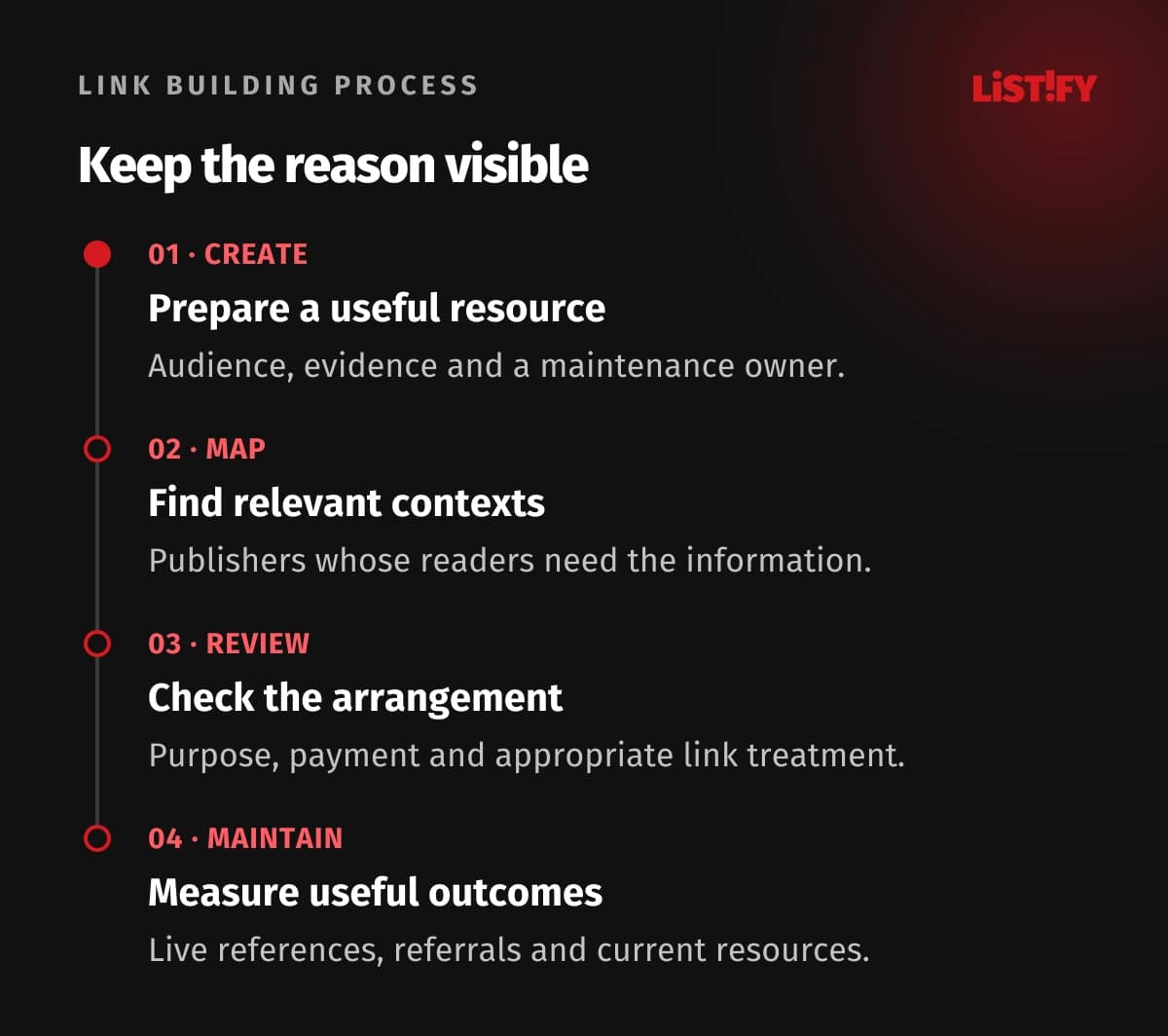
- Choose a useful resource. Define its audience, evidence and maintenance owner.
- Map relevant publishers. Identify genuine contexts where the resource helps readers.
- Review each arrangement. Check editorial purpose, payment, representation and link treatment.
- Measure and maintain. Inspect live placements, useful referrals and resource accuracy.
Start with one or two strong resources and a manageable set of relevant relationships. Improve the material from real questions and feedback. The work becomes more credible when the business can explain its knowledge and maintain the answer after initial promotion.
Keep link building connected to the wider website. Internal navigation, useful service pages, technical accessibility, and clear customer paths still matter. Our SEO strategy guide provides context for assessing link work alongside the rest of the search programme.
08Questions about link building in 2026
How many links should a small business obtain each month?
There is no useful universal quota. Choose work from relevant audiences, useful resources and sustainable effort. A volume target alone can encourage weak or manipulative placements.
Are all paid links forbidden?
Advertising and sponsorship can be legitimate. Google distinguishes appropriately qualified paid links from buying ranking credit. Review visible disclosure and applicable rules separately from the technical link attribute.
Does a high authority score prove a good placement?
No. Third-party scores are estimates. Inspect the actual page, audience, editorial purpose, surrounding content and arrangement before deciding whether it is useful.
Are guest articles always link spam?
No. A relevant expert contribution can serve readers. Review the purpose and arrangement, especially paid ranking credit, optimized anchors and low-value content produced mainly to manipulate linking signals.
Should we disavow every link a tool calls toxic?
No. Google's tool has limited circumstances and misuse can harm performance. A third-party label alone does not establish the need to disavow.
Can a supplier guarantee a particular Google position?
Treat that promise cautiously. Rankings depend on many factors, and a placement report does not prove future impact. Agree reviewable work and meaningful evidence instead.
What should the monthly report include?
Show actual pages, their context and arrangement, destinations, relevant qualification, useful referrals, and resource maintenance. Explain the limits of search attribution rather than equating link count with growth.