How to choose a web application stack: React, Node.js and alternatives
One proposal promises React, another recommends Node.js and a third offers rapid development in Python. They may be describing different parts of the same system. Start with the work your users need to complete, test the biggest uncertainty and decide who will maintain the result.
01React and Node.js solve different problems
React is a library for building user interfaces. Node.js runs JavaScript outside the browser. A single application can use both. Asking which one to choose does not define a meaningful comparison. Compare complete options that include the interface, server logic, database, integrations and operating arrangements.
The React documentation explains components, while Node.js describes a runtime for network applications. A framework built around React can also handle routing and server rendering. Naming a library does not tell you whether a proposal includes account management, administration or backups.
02Make five product decisions first
Write one page describing who uses the application, what they must finish, where the information comes from, what happens during an outage and who owns operations. A useful scenario might be: a salesperson prepares a quotation from the company price list, a manager approves an exception and the customer receives a document. That reveals more than a list of favourite languages.
- Public or authenticated: A public catalogue needs discoverable content and dependable URLs. An internal tool mainly needs a reliable workflow.
- Interaction: A simple form differs from a scheduling board that updates as people work.
- Integrations: List accounting, CRM, payments and identity systems, together with available documentation.
- Data and access: Define sensitive information, user roles and separation between customer organisations.
- Operations: Agree service hours, incident ownership and acceptable loss of work in progress.
Separate essential requirements from later additions and untested assumptions. If an indispensable integration only works in a particular environment, it may outweigh the team's frontend preference. Surface those constraints before comparing prices.
03Compare approaches against the project
| Approach | When to consider it | What to examine |
|---|---|---|
| Ready-made platform or CMS | Content sites, standard sales and common record keeping | Customisation limits, exports, licensing and extensions |
| Server application with templates | Forms, approvals and moderately interactive portals | Complex screens and incremental interaction |
| React with an appropriate framework | Interactive products, editors and customer portals | State management, rendering, accessibility and JavaScript weight |
| Node.js on the server | APIs and integrations with an experienced JavaScript team | Long calculations, background jobs and dependencies |
| Django, Laravel, .NET or Spring | Applications with substantial business rules | Required libraries, maintenance and available expertise |
This is a decision aid, not a performance ranking. Several approaches can deliver the same product well. An unreliable integration, incorrect permission rule or neglected maintenance will not become sound simply because somebody changes the programming language.
04Decide how much frontend complexity you need
Consider React when a screen combines filters, dragging, partially completed forms, live previews and shared work. Components help divide that interface into reusable pieces. The official guidance for new React applications recommends suitable frameworks and also discusses building from scratch for particular constraints.
A content website does not automatically need an independent frontend and separate API. Each layer brings additional contracts, deployment steps and tests. For a portal with a handful of forms, ask to see server templates with progressively added interaction as another option. Choose the approach that supports the actual workflow and remains understandable.
Apply the same reasoning to Vue or Svelte. Popularity is not an acceptance test. Ask whether the team can handle localisation, keyboard use, complex tables, error states and transfer to another supplier. Include the difficult parts of your interface in the prototype rather than approving the stack from a home page demonstration.
05Choose the server around workload and team skills
Node.js may suit a team already comfortable with JavaScript or TypeScript. Sharing a language does not remove the boundary between browser and server: the server still validates inputs and permissions independently. Node.js documentation warns about blocking the event loop. Evaluate expensive calculations separately and test background workers or job queues where appropriate.
Django includes facilities for data models, templates and administration. Laravel provides an integrated environment for PHP web applications. Those capabilities may reduce assembly work, although they do not establish suitability for every project.
If your organisation already operates .NET or Java applications, involve that team early. Introducing a language needs a concrete reason, such as a required integration or specialist library. Replacing a working application to follow a trend can postpone useful features while introducing fresh defects.
06Treat architecture and storage as separate choices
For orders, invoices and permissions, define relationships and rules before selecting a database. How will the system prevent an order being confirmed twice? What happens when a webhook is repeated? Where can a manager trace an approval? Choosing React does not answer any of those questions.
For an initial product, we recommend evaluating one application with clearly separated modules. This is a starting point to test, not a universal prescription. Separate services become useful when there is a specific reason to separate workload, ownership or operations. More services also mean more interactions to monitor and recover.
Ask how changes to the data model will be deployed, how older integrations remain usable and how failed jobs are retried safely. These decisions can affect reliability more than a small difference in a framework benchmark. Record the trade-offs in language that the product owner can understand.
07Verify search visibility and speed on real pages
No framework guarantees leading search positions. Public pages need useful content, crawlable links, clear titles, appropriate canonical URLs and correct response codes. Decide which content is generated in advance, which is rendered on the server and which appears in the browser. Check caching rules for personal information as well.
Include a key page on an ordinary phone and a slower connection in acceptance testing. Measure the complete journey with images, analytics and external services enabled. An empty demonstration project does not establish the speed of your future product. Compare options using equivalent data, configuration and load.
08Use a prototype to resolve the largest uncertainty
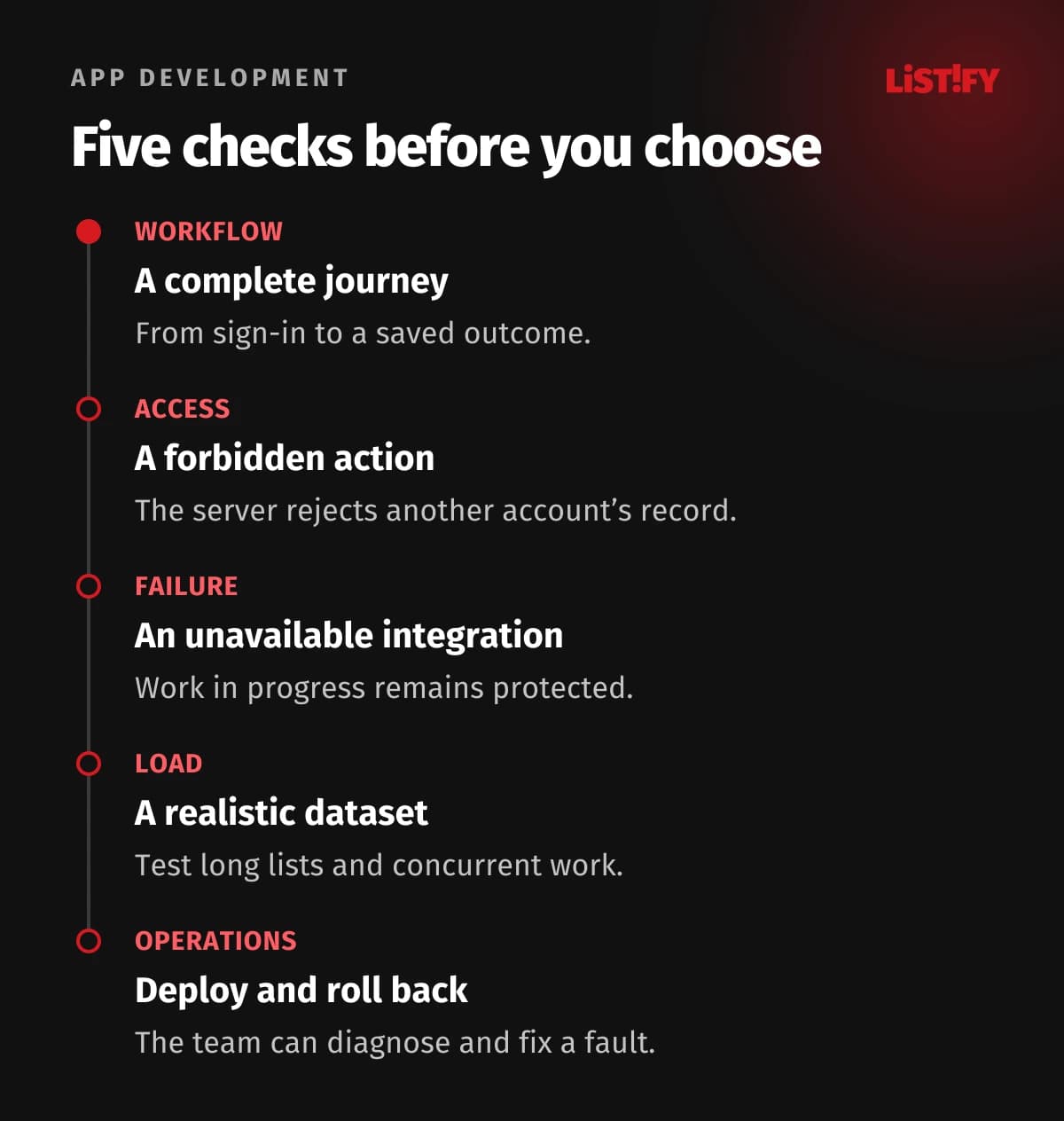
Choose one journey from signing in to saving the outcome. Use a realistic volume of test data and the actual interface of the critical integration. Agree acceptance conditions first: who may perform the action, what response time is acceptable and what appears when something fails. The demonstration should produce evidence for a decision.
- Complete the normal journey and attempt a specific forbidden action.
- Simulate an unavailable API, a slow response and a repeated submission.
- Work with a realistic list and concurrent users.
- Demonstrate deployment, rollback and fault diagnosis.
- Record results, open questions and the recommended option.
Watch how the supplier handles a failure during this exercise. Can the team find it in logs and explain the remedy? If the result depends on undocumented manual steps performed by one person, include that operational dependency in the evaluation.
09Calculate three-year costs and the cost of handover
Include discovery, development, licences, hosting, monitoring, fixes, upgrades, support and handover. Separate initial costs from recurring services. A smaller first invoice does not necessarily mean lower running costs, while a larger invoice does not establish a better architecture.
A working model is: three-year cost = initial work + 36 × monthly operations + planned changes and upgrades. Populate it with your own quotations and scope; it is not a market price estimate. Mark assumptions separately from contracted services. Relate contingency to specific uncertainties rather than adding an unexplained percentage.
Request the list of important dependencies, ownership of accounts and code, and deployment instructions. Verify data export and whether another team can run the project. Finally, write a short decision record covering the options, selection reasons and circumstances that would trigger a review. It should remain useful when people or suppliers change.
10Compare Vue, Svelte and Angular as well
Vue supports progressively introducing components into an interface. Nuxt adds rendering options around Vue. SvelteKit supports application development with Svelte. Angular supplies integrated tools including routing and forms. They organise similar development needs differently.
| Candidate | Reason to consider it | Decisive evidence |
|---|---|---|
| React with a framework | A team with proven components and relevant interface experience | Library choices and server/client boundaries |
| Vue and Nuxt | Progressive adoption or established Nuxt experience | Integrations, rendering state and extensions |
| Svelte and SvelteKit | A team that can demonstrate the required components | Complex tables, editors and future handover |
| Angular | Several developers benefit from established shared conventions | Training, upgrades and actual product complexity |
These are our selection recommendations, not claims of lower cost or greater speed. Give every candidate the same acceptance scenario. The decision can then rest on delivery and maintenance evidence rather than individual preference.
11Three illustrative projects and candidate stacks
Internal approvals: Evaluate Django or Laravel with server templates, a relational database and company SSO. Approval sequence, audit history and export matter most. Add a separate frontend if the screen workflow justifies it.
A customer SaaS portal: Compare React with a framework and Node.js against a Vue/Nuxt option. Include a relational database, identity management, file storage and a queue for longer jobs. Test customer separation, recurring billing and integration failures.
A data workbench: Consider React or Vue for interaction and a separate Python service for specialist calculations. Demonstrate a real calculation, the waiting experience and safe retries. These are candidate designs, not universal prescriptions or claims of identical performance.
12Include release support in the agreement
Request the version inventory, support end dates and upgrade ownership. For example, Node.js distinguishes active LTS, maintenance LTS and end-of-life releases. Launching on an unsupported release creates an operational problem from day one.
Handover evidence should include a clean build, a dependency update, a test backup restoration and known limitations. For SEO, request checks of rendered HTML and indexing using Google Search Central guidance. Keep results, versions and test conditions together.
Our web application scalability guide develops the growth question further. A stack decision should support that plan while leaving room for evidence from the running system.
13Common questions about selecting a stack
Is React suitable for every web application?
It suits many interactive interfaces, but a simple content page or form may not need it. Compare screen complexity, team experience and maintenance of the complete setup.
Can React work with Python or PHP?
Yes. The interface can communicate with a server through an agreed API regardless of the server language. Clear communication rules, security and operational ownership still matter.
Does one language across the stack reduce cost?
It can simplify collaboration for a particular team, but savings depend on the scope. Server permissions, data management and operations remain separate responsibilities.
Should a growing application be rewritten?
Measure the constraint first. A database query, cache, background job or local change may solve it. Compare a rewrite with these alternatives and with its effect on ongoing product development.
What should a supplier's proposal contain?
The complete solution, operational ownership, verified integrations, maintenance costs and handover terms. A list of technologies alone is insufficient for an informed decision.
Choosing a supplier or a stack? Discuss the main workflow, integrations and operational responsibilities through our web application service. Those decisions form a brief against which proposals can be compared.