ISO 27001: when certification makes sense and how it works
A prospective enterprise customer asks for an ISO 27001 certificate. The immediate question is commercial, but the work reaches far beyond the sales team: access decisions, suppliers, development, incident response and management accountability. Certification makes sense when the business can sustain the system behind the certificate.
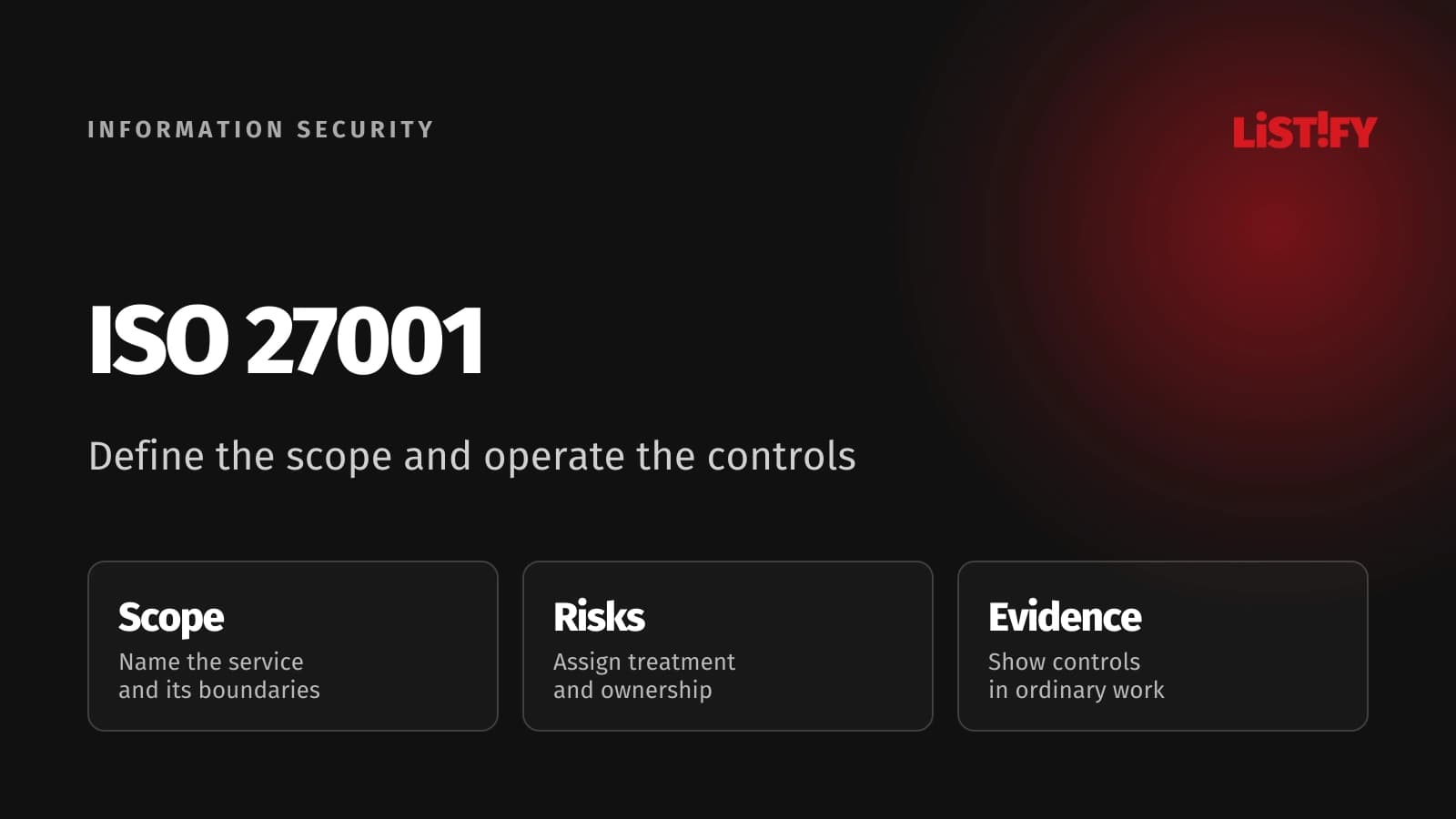
Begin by separating the customer’s purchasing requirement from the security improvements your organization needs. A deadline in a tender does not establish that an audit can be completed before it, or that a narrowly defined certificate will meet the buyer’s expectation.
A useful decision names the relevant services, the people responsible, the gaps to resolve and the ongoing operating cost. This provides a basis for choosing certification now, preparing for it later or improving security without an immediate certification project.
01Understand what the certificate actually covers
ISO describes ISO/IEC 27001:2022 as a requirements standard for an information security management system, or ISMS. The system organizes how the organization assesses and treats information security risk. It includes people, responsibilities and processes as well as technology.
Certification applies to the ISMS within its stated scope. A certificate covering the operation of a particular hosted service does not automatically establish that every product, office and subsidiary is included. Read the scope before making a purchasing decision or a marketing claim.
For a software company, that boundary might include development and operation of its customer portal, the supporting team and relevant locations. Describe it clearly enough that a customer can connect the certificate to the service they intend to buy.
A management-system certificate is not proof that an application has no vulnerabilities or that incidents cannot occur. Continue technical assessment, secure development and recovery work. Independent assurance has value when its limits are understood.
ISO itself does not conduct certification or issue certificates. ISO’s certification guidance explains the role of external certification bodies and accreditation. Choose a suitable independent body and verify the relevant accreditation and scope rather than relying only on a recognizable badge.
Keep the contractual question specific: which legal entity, service scope, standard edition and assurance does the customer require? Ask for the purchasing requirement in writing before treating certification as the answer to every security questionnaire.
02Build a business case before setting the audit date
A repeated requirement from qualified customers can justify investment, especially when the same operating improvements support the services you already run. Record the actual opportunities and procurement conditions. Avoid treating a sales forecast as guaranteed revenue from certification.
| Situation | Useful next step | What to establish first |
|---|---|---|
| Customers require a relevant certificate | Assess readiness and certification scope | The requirement matches the service being purchased |
| Security work lacks consistent ownership | Build the management system | Leadership can fund and operate the processes |
| A one-off buyer asks about security | Clarify acceptable assurance | A questionnaire or other evidence may be sufficient |
| Serious technical weaknesses remain | Prioritize remediation and risk treatment | The plan addresses real exposure before an audit deadline |
Account for internal effort as well as the certification-body fee. Staff will map responsibilities, repair gaps, maintain records and participate in audits. Access cleanup, recovery exercises or changes to supplier arrangements can consume more effort than writing the policy documents.
Estimate recurring work separately from initial preparation. Identify who will review access, maintain the risk assessment, coordinate audits and track corrective actions after the certificate is issued. A plan that depends on constant unpaid overtime is unlikely to remain effective.
Do not assign a fixed number of weeks before inspecting the starting position. A company with established controls and reliable evidence has a different preparation task from one that cannot identify production access or demonstrate recovery.
Compare the case with other necessary work, including the security of custom software. Certification should support concrete improvements to the way the service is built and operated.
03Define a scope that reflects the real service
Start with the information and services that matter, then identify their dependencies. Map the systems, staff, locations, suppliers and processes involved in handling that information. Include the interfaces between the proposed scope and the rest of the organization.
For a hosted document portal, support access, deployment permissions and backup administration can affect customer information even if those activities sit in different teams. A scope statement should make those relationships understandable instead of drawing a convenient boundary around only the application code.
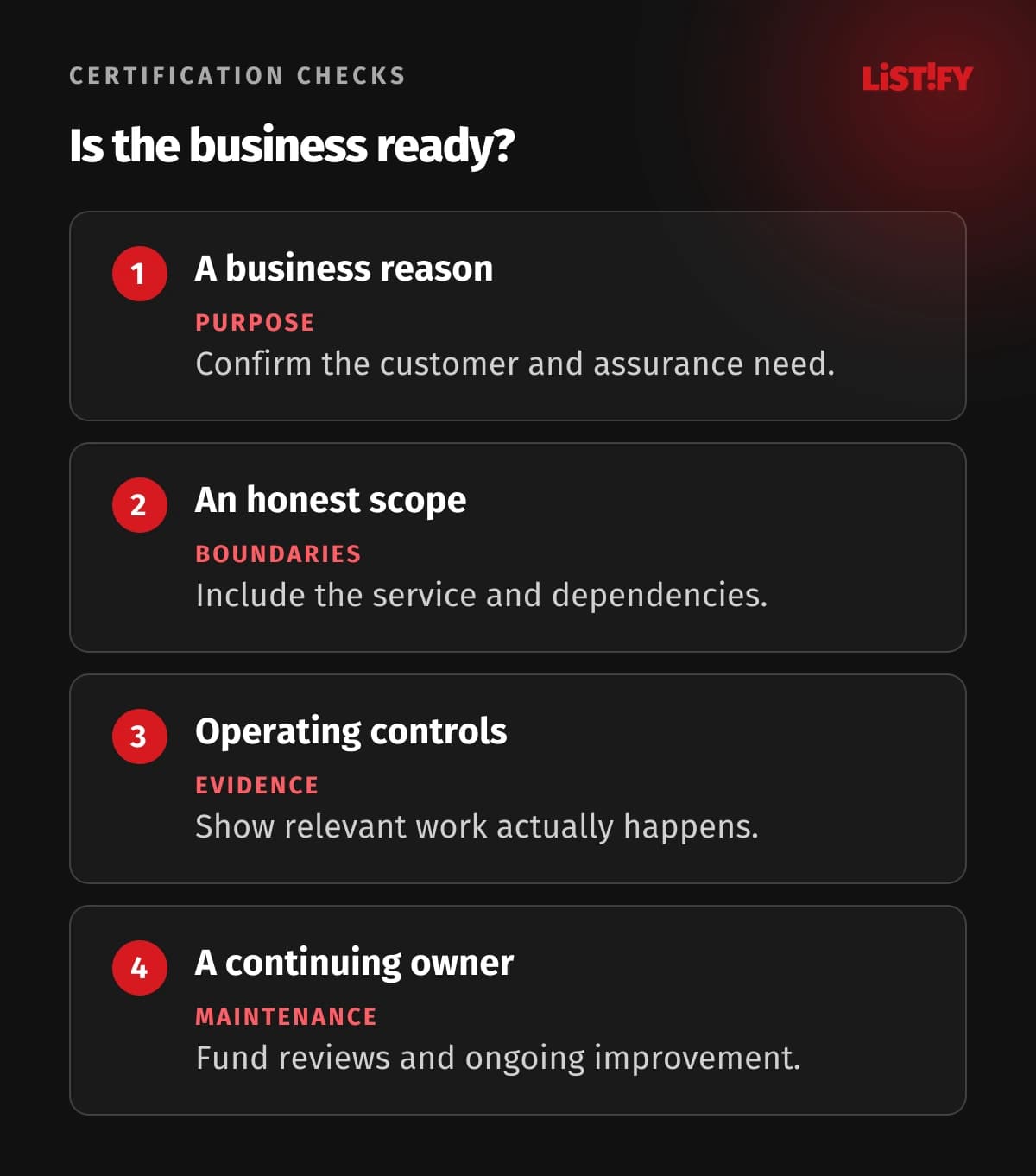
Assign an executive sponsor with authority to resolve competing priorities, and an ISMS owner who coordinates the work. Give individual risks and controls identifiable owners. The coordinator should not become the person who silently performs every department’s responsibility.
Inventory relevant supplier services and understand what assurance each provides. A cloud provider’s certificate can support your supplier assessment, but it does not certify your configuration, staff practices or application. Review the activities your team still controls.
The cloud responsibility guide helps frame those boundaries. Ask who manages identities, approves changes, tests recovery and responds when a supplier service is unavailable.
Use a gap assessment to turn findings into owned tasks. Record the required change, evidence expected and dependency on other work. Review the proposed scope with the certification body early enough to avoid discovering a mismatch after extensive preparation.
04Connect risk treatment to controls and evidence
Evaluate plausible events that could compromise information, then record their consequences and the existing protection. Agree a repeatable assessment method and risk-acceptance criteria. The output should help owners make decisions, rather than produce scores that nobody can explain.
For example, a departed contractor retaining deployment access is a specific risk scenario. Identify how access is removed, who checks completion and how exceptions are handled. That gives the team an observable control rather than a broad instruction to be secure.
BSI’s client guide explains the Statement of Applicability. It records selected controls, reasons for inclusion or exclusion and implementation status. Consider the Annex A reference controls in your risk treatment; additional controls may also be needed.
Do not interpret this flexibility as permission to remove the core ISMS requirements. Nor should the team implement every reference control identically without considering its relevance. The documented selection needs to make sense for the defined scope and risks.
Link each important treatment to an owner and evidence of operation. Examples include a completed access review, a restore exercise with recorded results, an approved change and an incident exercise with follow-up tasks. A policy states intent; these records help show what happens in practice.
Make evidence collection part of ordinary work. Save approvals in the workflow, capture the outcome of routine reviews and keep records accessible to authorized people. Reconstructing everything immediately before an audit invites gaps and makes the system harder to maintain.
05Test the system before independent assessment
NQA’s ISO 27001 overview describes leadership, risk treatment, internal audits, management review and improvement as parts of the ISMS. Preparation therefore includes checking whether the processes operate, not simply assembling a folder of documents.
Plan internal audits that can examine the relevant activities objectively. Give the reviewer enough access and competence to test the process against its criteria. Include the evidence behind claims, such as whether removed users really lost the relevant privileges.
Use findings to correct the immediate problem and investigate why it happened. If a leaver retained access because the HR notification never reached the service owner, changing that one account is only part of the response. Fix and verify the handoff.
Management review should give leadership useful information about risks, performance, findings and required resources. Record decisions and follow-up ownership. A meeting that approves a presentation without addressing unresolved problems does little to improve the service.
Run practical exercises where they support the selected controls. A restore exercise can reveal missing credentials or undocumented dependencies. A response scenario can show whether the incident owner can reach the people needed to make a decision.
Schedule the external assessment when the team can demonstrate operation and resolve the readiness gaps. Confirm evidence expectations with the certification body. A preferred launch date should not substitute for those prerequisites.
06Plan the audit and the work after certification
NQA describes an initial assessment in two stages: a readiness and documentation assessment followed by evaluation of implementation using objective evidence. The certification body sets the detailed assessment arrangements for your scope.
Prepare people to explain their normal work and locate records. An access owner should understand how rights are reviewed; a service owner should know how incidents are handled. Rehearsing polished answers is less useful than making the actual process coherent.
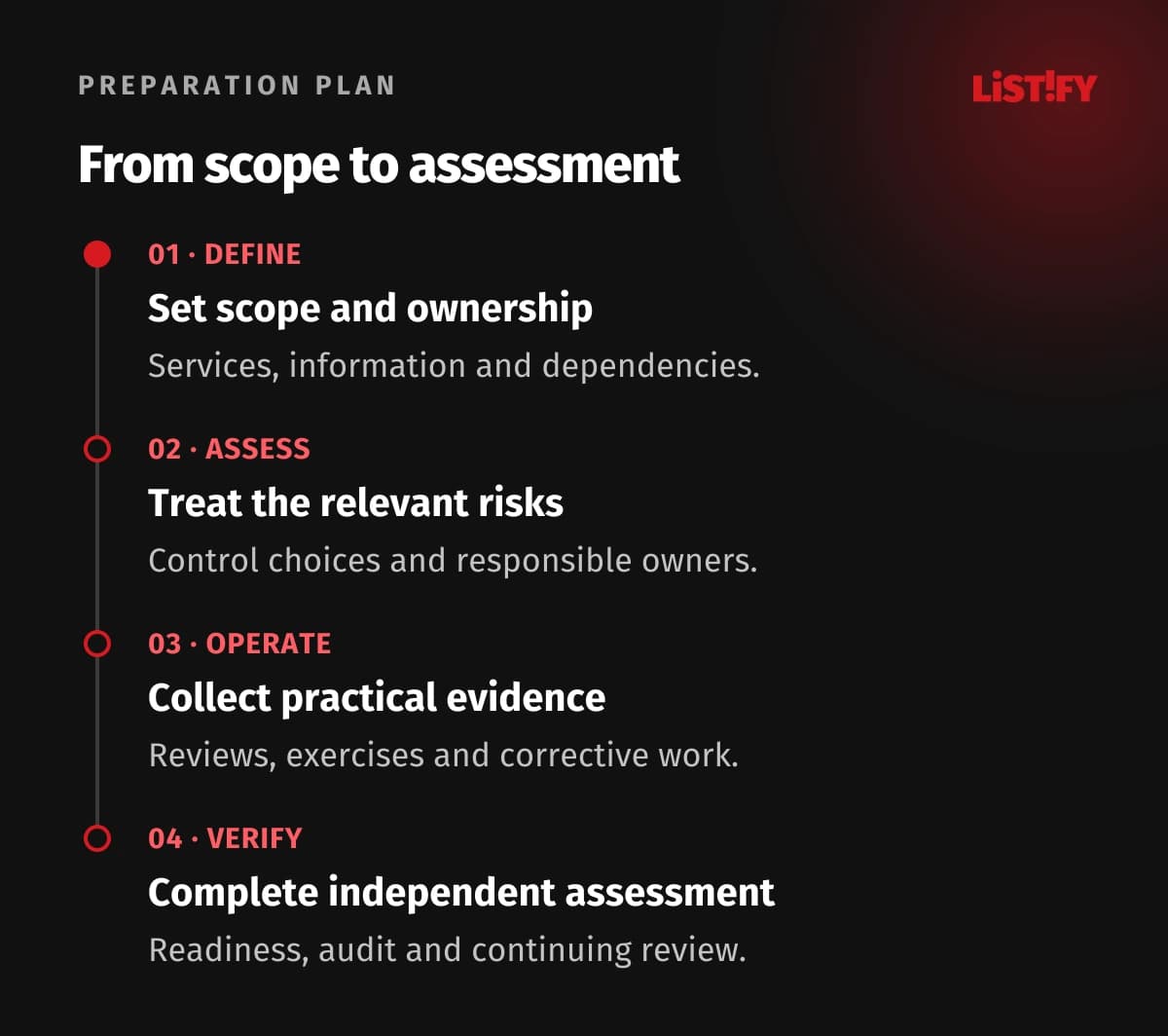
If the assessment identifies nonconformities, address them through corrective action and the required verification. Certification depends on the body’s decision, not merely on attending the audit. Agree how findings will be handled and what evidence is needed.
Maintain a calendar for ongoing reviews and subsequent assessments. Certification involves continuing surveillance and recertification rather than a permanent pass. Ask the body for the schedule, audit effort, change-notification requirements and conditions for maintaining the certificate.
Review scope when the business adds services, changes locations or reorganizes responsibilities. A sales team should not describe a newly launched service as covered merely because the company already has a certificate for other work.
Keep public claims precise and use certification marks under the issuing body’s rules. ISO’s guidance says the ISO logo cannot be used to claim certification. Make the service scope and current certificate easy for a customer to check.
07Questions about ISO 27001 certification
Is ISO 27001 only suitable for large companies?
The standard can apply to organizations of different sizes. The useful question is whether the business needs the assurance and can operate the management system. A small team still needs clear responsibilities, relevant controls and evidence.
Does a certificate cover every product we sell?
Coverage depends on the stated ISMS scope and certified organization. Review the certificate and the relevant service boundaries. Do not assume a new product, subsidiary or location is included without checking.
Must every Annex A control be implemented?
The reference controls need consideration, with justified inclusion or exclusion recorded in the Statement of Applicability. Selection follows the risks and requirements of the scope. The core management-system requirements still apply.
Does certification automatically satisfy privacy or cybersecurity law?
Do not treat the certificate as blanket proof of legal compliance. Applicable obligations depend on the organization, activities and jurisdictions. Identify those requirements separately and connect the relevant security work with them.
How much will preparation cost?
Estimate from the actual scope and gaps. Include staff time, technical remediation, external help where needed, certification assessment and ongoing maintenance. A universal quoted price cannot capture those differences.
Can our cloud provider’s certificate replace our own?
It can provide assurance about the supplier’s certified activities. It does not cover all of your application, configuration and operating responsibilities. Map the dependency and retain evidence of the controls your organization owns.
What happens after the certificate is issued?
Continue operating and improving the ISMS, keep evidence and prepare for surveillance and recertification. Review important changes with the certification body and ensure customer-facing claims still match the scope.