App monetization models: subscriptions, in-app purchases or ads?
For apps people use regularly, subscriptions are usually the most reliable way to earn. In-app purchases work when users pay for something specific, and ads only pay off once an app has a really large audience. Many of the most successful apps combine all three. Here is how much of the price you actually keep after Apple and Google take their share, what numbers to expect, and how to pick the right model.
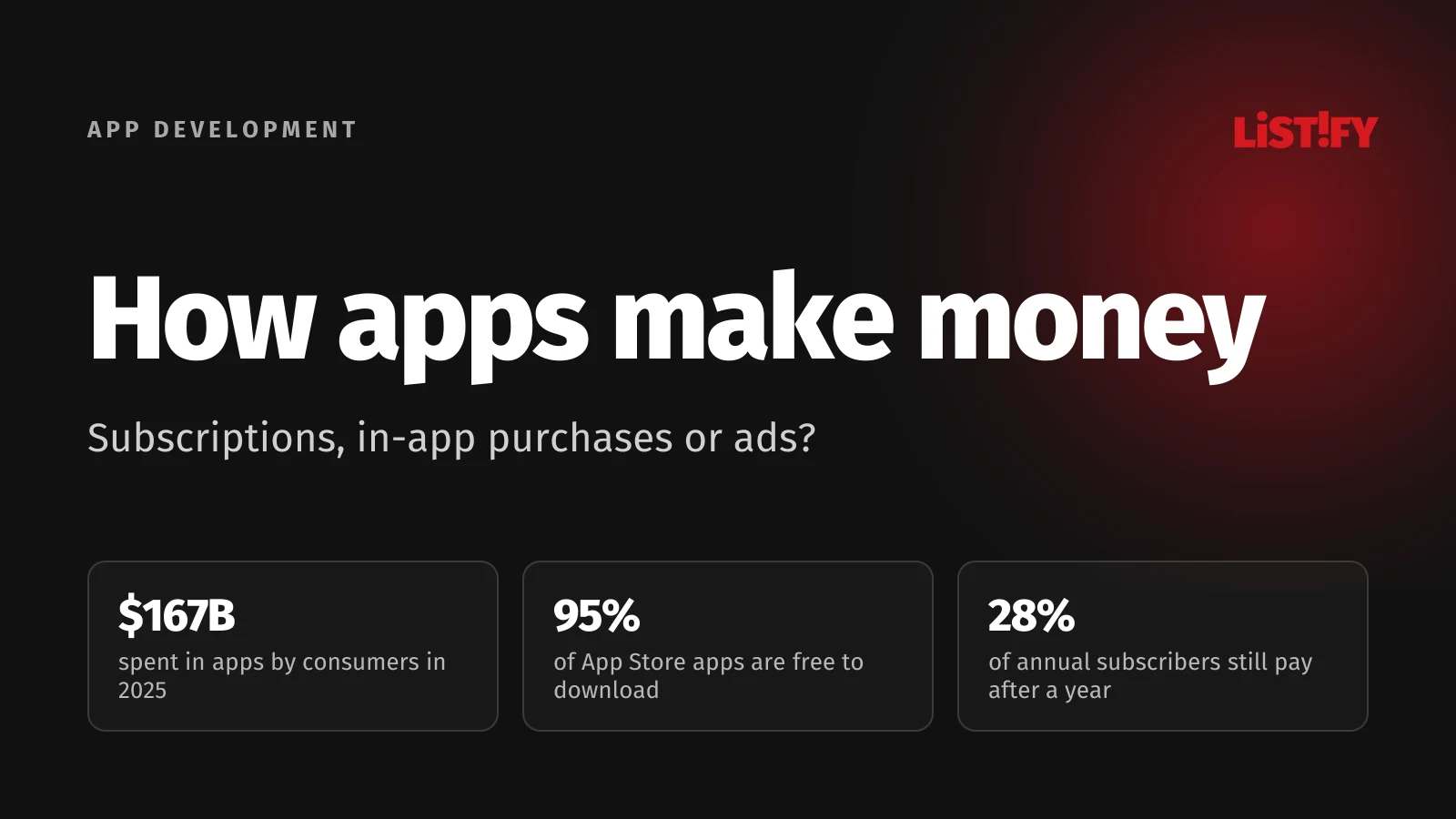
Consumers spent a record $167 billion on in-app purchases and paid apps on the App Store and Google Play in 2025, yet almost every app in the stores is free to download. According to a live count by 42matters, 95% of apps on the App Store and 97% on Google Play cost nothing to install as of September 27, 2026. Free to download rarely means free, though. Somebody pays, and the question is who, for what, and when.
There are three basic ways to make money from an app: subscriptions, in-app purchases and advertising. Each fits a different kind of app, each has different math, and each means someone else takes a cut. This guide compares the three using real data, lists the app store fees that apply in 2026 and works through what an app can realistically earn in its first year.
01The short answer: which model when
| Model | How it earns | Best for | Example |
|---|---|---|---|
| Subscriptions | Recurring payment per month or year | Apps people open often and keep getting value from | Duolingo Super, Spotify Premium |
| In-app purchases | One-off payment for a specific item | Games, unlocking a feature, content packs | Free-to-play games |
| Advertising | The advertiser pays, the user pays nothing | Apps with a large audience that spends a lot of time in them | Free games, utilities, news |
| Hybrid | Free with ads, paid tier with extra features | Apps where only a minority pays and the rest still need to earn money through ads | Duolingo, Spotify |
There is also the paid app, bought up front before the first launch. Today it is the exception. Most apps that charge anything do it inside the app, using one of the three models above, or a mix of them.
02How much money is spent in apps
The money is there, and it keeps growing. Sensor Tower calculates that consumers spent $167 billion on in-app purchases and paid apps across the App Store and Google Play in 2025, up 10.6% year over year. For the first time, spending in non-game apps overtook games: non-game in-app revenue grew 21%, games just 1.3%. The United States remained the largest market with nearly $60 billion (Sensor Tower).
Advertising is just as big a business. According to a study commissioned by Apple, developers in the App Store ecosystem earned $151 billion in 2025 from ads placed in their apps, while sales of digital goods and services reached $149 billion (Apple). In total, ads and paid content are worth about the same, but ad money flows mostly to apps with huge audiences.
Where your users live matters as much as the model. RevenueCat, whose subscription platform is used by more than 115,000 apps, found large regional differences in how many users pay and how much each one is worth (RevenueCat).
- North America2.6%
- Western Europe2.0%
- Latin America1.5%
- India and Southeast Asia1.4%
Median subscription app, 2025 data. First-year revenue per payer: $32 in North America, $25 in Western Europe, $14 in India and Southeast Asia. Source: RevenueCat, State of Subscription Apps 2026.
03What you keep: app store fees in 2026
Before you estimate revenue, take off two things. The first is tax. In the EU and many other countries, store prices include VAT, and Apple’s developer agreement states that its commission is calculated on the price net of taxes (Apple). The second is the store commission, and in 2026 it depends more than ever on where your users are.
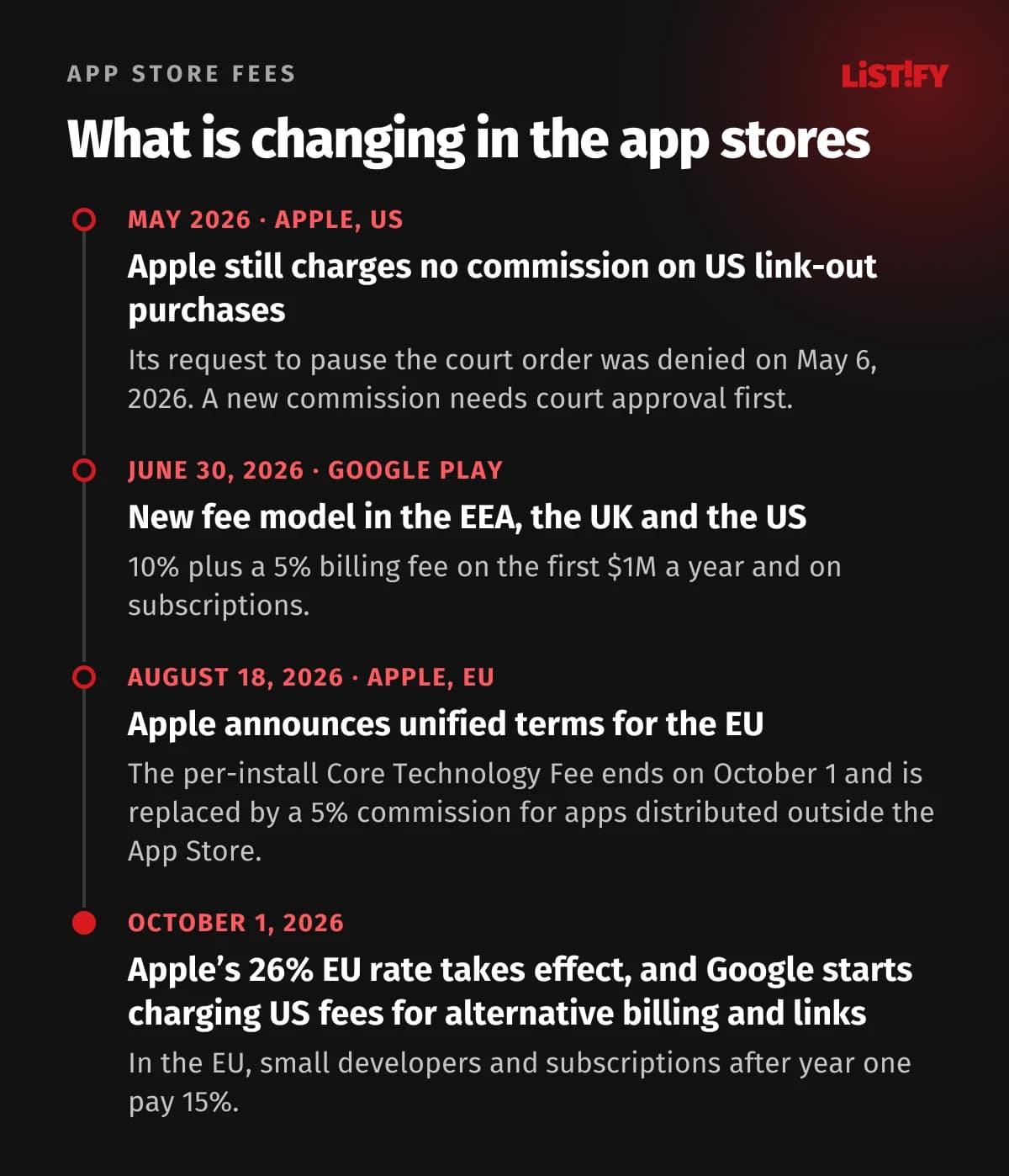
Google introduced a new fee model in the EEA, the UK and the US on June 30, 2026, while other markets keep the familiar 15% and 30% tiers (Google Play). Apple announced unified EU terms in August that take effect on October 1, 2026, or when a developer accepts them, whichever is later (Apple).
| What you pay | Apple App Store | Google Play |
|---|---|---|
| Developer account | $99 a year | $25 one-time |
| Standard in-app purchase | 30%, in the EU 26% from Oct 1, 2026 | EEA, UK, US: 15% (10% + 5% billing fee) on the first $1M a year, 25% to 30% above it. Elsewhere 15% on the first $1M, 30% above |
| Small developers | 15% in the Small Business Program, up to $1M in proceeds a year | 15% on the first $1M a year (outside the EEA, UK and US you must enroll in the 15% tier) |
| Subscriptions | 30% in year one (26% in the EU from Oct 1, 2026), then 15% | 15% from day one (10% + 5% billing fee in the EEA, UK and US) |
| Your own payment processing in the app | EU from Oct 1, 2026: 20%, or 10% for small developers and subscriptions after year one | EEA alternative billing: 10% on the first $1M |
| Physical goods and services | No commission, must be sold outside in-app purchase | No commission, Google Play billing must not be used |
The US is a special case. Since May 2025, App Store guidelines allow US storefront apps to include buttons and links to purchases outside the app. Apple currently charges no commission on those purchases: an appeals court barred it from doing so until a district court approves a new commission, and Apple’s request for a stay was denied by Justice Kagan on May 6, 2026 (Apple filing, Supreme Court docket). That can still change. On Google Play, fees for alternative billing and external links in the US apply from October 1, 2026 (Google).
Here is what that means on the App Store for a $29.99 annual plan, a common price at the low end of RevenueCat’s typical range ($29.99 to $39.99), assuming $29.99 is the price excluding tax. In the Small Business Program you keep $25.49. Without it, you keep $20.99 at the standard rate, or $22.19 in the EU from October.
- Price excluding tax$29.99
- You keep at 15%$25.49
- You keep at 26% (EU from Oct 1, 2026)$22.19
- You keep at 30%$20.99
Own calculation, rounded to cents. The 15% rate applies in the Small Business Program and to subscriptions after the first year. Income tax is still due on what you keep.
The last row of the fee table matters most to many businesses. If your app sells physical goods or services, such as food delivery, tickets or bookings, the store commission does not apply. Apple requires you to use a payment method other than in-app purchase, and Google forbids its billing system for these purchases (Apple, Google). You only pay your payment processor, just like on the web.
04Subscriptions: steady income you have to earn
Subscriptions bring recurring revenue you can plan around, and with Apple a lower commission once a subscriber passes the one-year mark. They only work when the app delivers value again and again: it helps with work, teaches, protects or saves time. Nobody keeps paying for an app they open twice a year.
RevenueCat’s report on 2025 data includes several numbers worth knowing (RevenueCat):
- Apps that ask for payment up front (a hard paywall) convert 10.7% of downloads to paying within 35 days. Freemium apps convert just 2.1%. After a year, though, retention is nearly identical for both models.
- Longer trials convert better. Trials of four days or less convert 25.5% of users to paid, trials of 17 to 32 days convert 42.5%. Yet nearly half of all apps now use trials of four days or less.
- Typical prices are $4.99 to $6.99 a week, $7.99 to $9.99 a month and $29.99 to $39.99 a year.
- After one year, 28% of annual subscribers are still paying, compared with only 8% of monthly subscribers.
- Annual plan28%
- Monthly plan8%
- Weekly plan1%
Median app, 2025 data, weekly plans around 1% according to the report. Source: RevenueCat, State of Subscription Apps 2026.
The practical takeaway: offer an annual plan and make it cheaper than twelve monthly payments. And build your subscription on trust. Show the price, the trial length and the automatic renewal clearly, not in the fine print. A user who feels tricked leaves, and often leaves a review that scares off the next one.
05In-app purchases: paying for something specific
One-off in-app purchases come in two forms. Consumables can be bought again and again: in-game currency, lives, credits, a pack of lessons. Non-consumables are bought once and kept forever: unlocking the full version, removing ads, a new theme or a map pack.
They are strongest in games. Free to play means the game costs nothing and earns mainly from a minority of players who buy items or speed-ups. Among subscription apps tracked by RevenueCat, games are about four times as likely as the average app to combine subscriptions with lifetime and consumable purchases (9.6% vs. 2.5%).
The rules are strict. Outside the US link-out exception and the EU alternatives described above, Apple’s guidelines require in-app purchase for features and digital content. License keys, QR codes or cryptocurrencies cannot be used to unlock content (Apple). Google has a similar rule, but offers alternative billing with a lower fee in the EEA (Google).
06Advertising: earning from attention
With ads, the user pays nothing and the advertiser pays instead. That is why advertising suits apps with a large audience that spends a lot of time in them: games, simple utilities, news, weather. The market is huge. In the US alone, digital advertising revenue reached $294.6 billion in 2025, up 13.9%, according to IAB and PwC (IAB). But a single impression is usually worth very little.
Google AdMob offers these ad formats (Google AdMob):
- Banner: a strip at the edge of the screen, the least intrusive format, and usually the lowest-earning one.
- Interstitial: a full-screen ad at a natural break, such as between game levels.
- Rewarded: the user chooses to watch it and gets a bonus in return, such as an extra life or credits.
- Native: styled to match the app’s content, for example as an item in a list.
- App open: shown when the user launches the app or switches back to it.
Be careful with interstitials. Google Play bans ads that appear unexpectedly, full-screen video ads before an app’s splash screen, and full-screen ads that cannot be closed after 15 seconds. The policy does not apply to rewarded ads that users explicitly opt into (Google).
Privacy rules also affect earnings. On iPhone, an app needs the user’s permission through App Tracking Transparency to track them across apps and websites. Without it, the device’s advertising identifier returns all zeros (Apple). In the EEA and the UK, AdMob has required a certified consent management platform integrated with the IAB TCF for personalized ads since January 16, 2024 (Google AdMob). Ads still run without consent, but they usually earn less.
Ad revenue is hard to predict in advance. Earnings per thousand impressions vary by country, format and audience, and published averages vary too widely to plan with. Until you see what ads actually earn in your app, treat them as a supplement, not your main income.
07Hybrid models: how Duolingo and Spotify do it
The big apps do not rely on a single model. Most users will never pay, so the app monetizes them with ads, while a paying minority brings in most of the revenue. Their annual reports show it clearly.
Duolingo made $1.04 billion in revenue in 2025. Subscriptions accounted for 84.2%, advertising for 7.7% and in-app purchases for 3.9%. It had 12.2 million paid subscribers, about 9% of monthly active users (Duolingo 10-K).
- Subscriptions84.2%
- Advertising7.7%
- Duolingo English Test4.0%
- In-app purchases3.9%
- Other0.2%
Share of $1,037.6M in revenue, own calculation from the annual report. Source: Duolingo, 10-K for 2025.
Spotify tells a similar story. Of €17.2 billion in 2025 revenue, Premium subscriptions brought in 89% and ads in the free tier 11%. It had 290 million paying subscribers (Spotify 20-F). Match Group, the owner of Tinder, shows the opposite approach: ads made up only about 2% of its 2025 revenue of $3.49 billion (Match Group 10-K).
The lesson from Duolingo and Spotify: ads in the free tier should never be so annoying that they drive users away, but they should give people a good reason to upgrade to the paid version.
08What an app can really earn: a worked example
Picture an app with a $29.99 annual plan that 10,000 people download in its first year. If it hits the medians from RevenueCat’s report, year one looks like this:
| Metric | Freemium | Hard paywall |
|---|---|---|
| Downloads | 10,000 | 10,000 |
| Conversion to paying within 35 days | 2.1% | 10.7% |
| Paying users | 210 | 1,070 |
| Net revenue per subscription | $25.49 | $25.49 |
| First-year revenue | about $5,350 | about $27,300 |
Two things stand out. First, how you ask for money matters as much as how many people download the app. The same 10,000 downloads bring in five times more behind a hard paywall. You can find our indicative development prices on the pricing page. Second, big wins are rare. According to RevenueCat, only 4.6% of newly launched subscription apps reach $10,000 in monthly revenue within two years.
That is why it makes sense to validate demand before you spend the whole budget, as we explain in From idea to MVP. And do not skip iPhone users: Duolingo earned 62% of its revenue through the App Store and 20% through Google Play. An app for both platforms is almost always a must, and our comparison of native and cross-platform development shows how to build one without paying twice.
09Choose your model in 6 questions
Before you decide, answer a few questions honestly. Often the answer becomes obvious from the way people actually use the app.
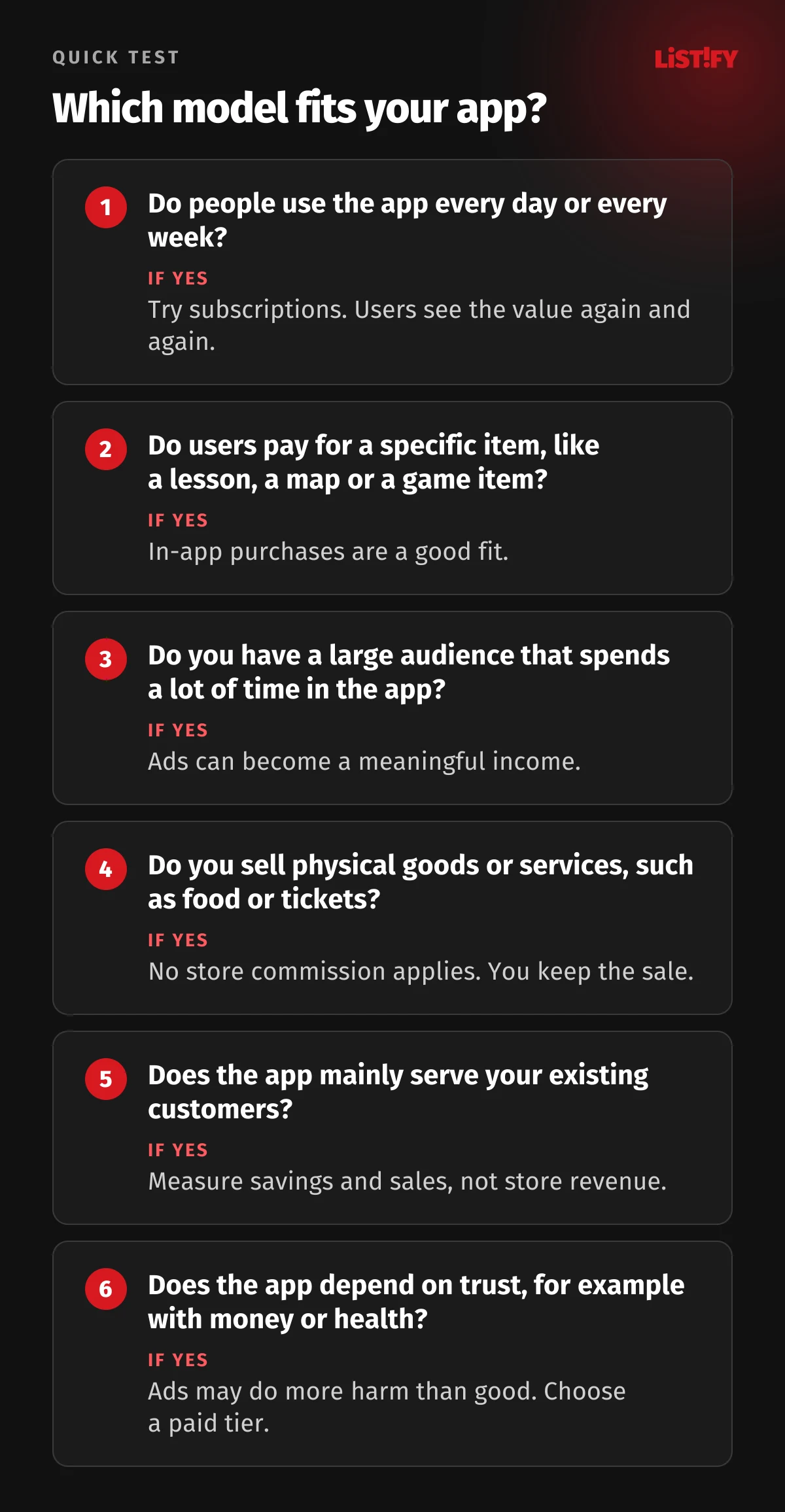
If your app mainly serves your existing customers, for example as a loyalty program, ordering tool or customer account, it does not have to make money directly. Its value lies in customers buying more often and needing less support. Judge that kind of app by the savings and sales it brings the business, not by what it earns in the store.
10The most common mistakes
- Adding monetization after launch. The model shapes the design of the whole app. Bolt it on later and the paywall feels foreign, while users have already learned that everything is free.
- Trials that are too short. Nearly half of all apps offer trials of four days or less, even though longer trials convert much better.
- Monthly plans only. Annual subscribers stay far longer. Offer both and make the annual plan the better deal.
- Ads everywhere. A full-screen ad after every tap drives users away faster than it earns, and it can break Google Play policy.
- Budgeting with the gross price. From a $29.99 plan you keep $20.99 to $25.49. Plan on net revenue.
- Hidden subscription terms. An unclear price or a silent automatic renewal leads to refunds and bad reviews.
- One platform only. Duolingo made 62% of its revenue through the App Store. Skip iPhone users and you leave money on the table.
11Frequently asked questions
How do free apps make money?
Mostly through a mix of a paid tier and advertising. Anyone can download the app, but only a minority pays for extra features or an ad-free version, while the rest bring in money through ads. According to 42matters, 95% of apps on the App Store and 97% on Google Play are free to download.
Which earns more, subscriptions or ads?
For apps people use regularly, usually subscriptions. Duolingo, for example, earned 84.2% of its 2025 revenue from subscriptions and only 7.7% from ads. Ads mainly pay off for apps with a large audience where only a small share of users would ever pay.
How much do Apple and Google take?
Usually 15% to 30%, and Apple calculates its commission on the price excluding tax. Small developers pay 15% on their first $1 million in both stores. Apple requires you to join its Small Business Program, and the limit counts proceeds from the previous year. Outside the EEA, UK and US, Google also requires you to enroll in its 15% tier. From October 1, 2026, Apple’s standard rate in the EU is 26%. Apple’s subscription commission drops to 15% after the first year, while Google takes 15% on subscriptions from day one.
Do I have to use Apple’s and Google’s in-app purchase?
For digital content and features, generally yes. Apple allows alternative payment options in the EU and Google in the EEA, both for a lower fee. US App Store apps may link to purchases on the web, and Google Play in the US also allows alternative billing and links, with fees from October 1, 2026. Physical goods and services, such as food, tickets or bookings, must not be sold through in-app purchase, and no commission applies to them.
What share of users will pay for an app?
According to RevenueCat’s 2025 data, the median subscription app converts 2.6% of downloads to paying within 35 days in North America and 2% in Western Europe. Apps with a hard paywall convert 10.7%, freemium apps 2.1%.
Can I change my monetization model later?
Yes, but the earlier you choose, the easier it is. Charging for a feature people are used to getting for free is always a sensitive move. We recommend designing the model into the first version of the app and then fine-tuning prices, trials and the offer based on data.
12Sources
- Apple: App Store terms in the EU
- Apple: Small Business Program
- Apple: auto-renewable subscriptions
- Apple: App Review Guidelines
- Google Play: service fees
- Google Play: payments policy
- Google Play: ads policy
- Sensor Tower: State of Mobile 2026
- RevenueCat: State of Subscription Apps 2026
- IAB and PwC: Internet Advertising Revenue Report 2025
- Duolingo: 2025 annual report (10-K)
- Match Group: 2025 annual report (10-K)
- Apple: Developer Program License Agreement
- Apple: App Store ecosystem study 2025
- Apple: user privacy and App Tracking Transparency
- US Supreme Court: docket 25A1213
- Google Play: US alternative billing
- Google Play: EEA alternative billing
- Google AdMob: ad formats
- Google AdMob: consent requirements in the EEA and UK
- Spotify: 2025 annual report (20-F)
- 42matters: App Store statistics